

Table of Contents
- Why Durable Colorful Home Decor for Daily Use Beats Trend Pieces
- Best Materials for Durable Home Decor
- Vibrant Home Decor for Everyday Living: Picks That Work as Hard as They Look
- How to Maintain Colorful Home Accessories So They Keep Their Color
- Multi-Functional Colorful Decor for Small Spaces
- Durability Checklist: What to Look For Before You Buy
- How to Mix Bold Color Without Clutter
- Frequently Asked Questions
Last Updated: September 17, 2026
Why Durable Colorful Home Decor for Daily Use Beats Trend Pieces
The home decor market is valued at roughly $139 billion in 2026, according to Printful's home decor market analysis, and a growing share of that spending is shifting toward pieces built to survive real life rather than one season of photos. That shift matters because durable colorful home decor for daily use solves a problem trend pieces create: you buy something bright, it fades, pills, or cracks within months, and you replace it.
Best Materials for Durable Home Decor
The best materials for durable home decor are tightly woven polyester broadcloth, cotton-polyester blends, and glazed ceramic, because each resists fading, pilling, and structural breakdown better than loose weaves or unsealed finishes.
Fabric Weight and Weave: What Holds Up to Daily Handling
Fabric weight is the best predictor of how a textile ages: heavier fabrics resist thinning and pilling because more fiber per square inch does the work.
Ceramic, Cotton Blends, and Finishes That Resist Fading
Glazed ceramic is the most fade-resistant decor material available. The color sits under a glass-like glaze rather than on top of the surface, so it cannot rub off.
Vibrant Home Decor for Everyday Living: Picks That Work as Hard as They Look
Vibrant home decor for everyday living works when the piece has a job beyond looking good. The strongest picks are table pieces, pillows, and towels that get used, washed, and used again.
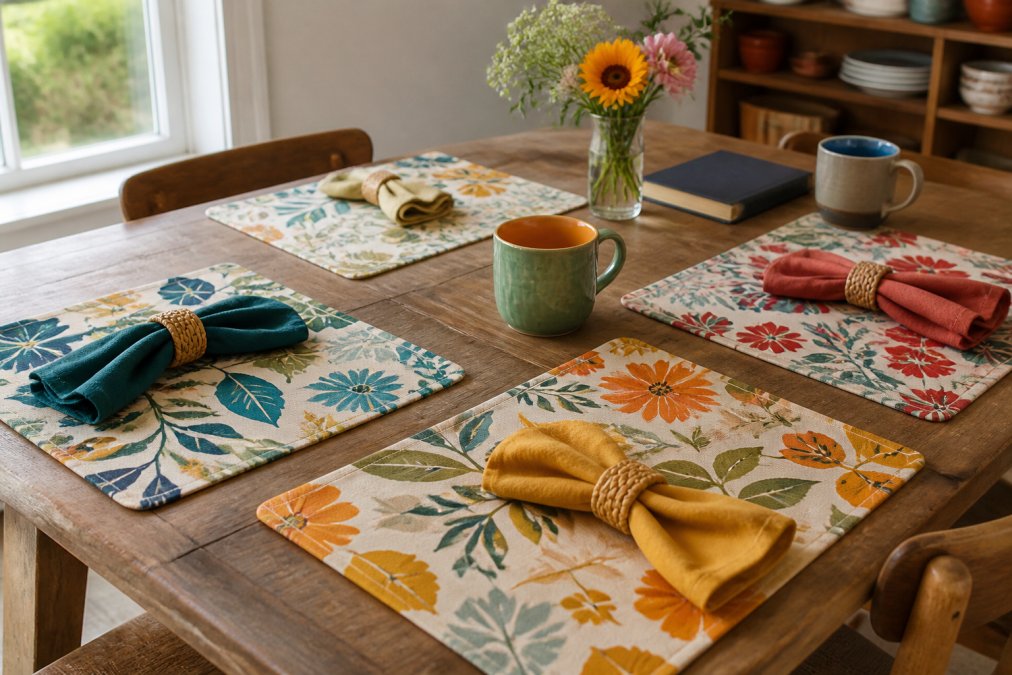
Table and Kitchen Pieces You Can Use Every Day
Start with the table, where decor meets daily friction: spills, heat, crumbs, repeat.
Pillows and Towels That Survive Real Routines
Pillows take more abuse than people expect: leaned on, napped against, tossed on the floor.
How to Maintain Colorful Home Accessories So They Keep Their Color
Colorful home accessories keep their color when you match the care method to the material, not a single blanket rule. Most fading comes from heat, UV, and abrasion, and each material fails differently: polyester releases dye when hot, cotton grays as fibers break down, and glazed ceramic chips when knocked rather than washed.
Here is what actually matters, material by material.
Printed Polyester Textiles (Placemats, Napkins, Pillow Covers)
Polyester holds dye tightly because the color is set into the fiber rather than sitting on top of it, but heat reverses that: hot water opens the fiber structure and lets dye escape, so a printed placemat washed hot dulls faster than one washed cold.
- Cold water only. The Salt Marsh Hand Towel label specifies a 90°F (30°C) maximum wash. Treat that as the ceiling for any printed polyester piece.
- Skip bleach, ironing, and dry cleaning. All three degrade printed surfaces: bleach attacks dye, iron heat can melt or glaze the print, and dry-cleaning solvents lift color unevenly.
- Air-dry or tumble low. High-heat drying dulls prints fastest. If you must use a dryer, choose the lowest setting and pull pieces while slightly damp.
- Wash decor textiles separately. A printed placemat washed with towels picks up lint and can set stains from other items.
- Rotate your sets. Even wear beats uneven wear, and rotating two sets doubles the life of both.
Cotton and Cotton-Blend Textiles
Cotton is more absorbent than polyester but breaks down faster. Repeated washing abrades the fiber surface, causing the gray, fuzzy look on older cotton towels and napkins. A cotton-polyester blend slows that: polyester adds strength while cotton keeps the hand-feel soft.

- Wash cold and avoid overloading. Friction between items in an overloaded drum is a leading cause of pilling.
- Use a mild detergent. Harsh detergents strip natural cotton oils and accelerate graying.
- Air-dry when you can. Cotton tolerates a dryer better than polyester, but line-drying preserves both color and fiber structure longer.
Glazed Ceramic (Mugs, Small Decor)
Glazed ceramic is the most fade-resistant decor material available because the color sits under a glass-like glaze rather than on top of the surface. It cannot rub off the way a surface print can. The failure mode is physical, not chemical: chips and cracks from impact.
- Dishwasher and microwave are fine when the maker states it. The All the Loves Graffiti Love-Black Glossy Mug and similar lead and BPA-free glossy mugs are built for both.
- Wipe rather than soak when the design sits above the glaze. Some mugs carry a printed design on top of the glaze, and prolonged soaking can lift it. Check the maker's care line.
- Stack with a buffer. A felt pad or paper napkin between stacked mugs prevents rim chips, the most common ceramic failure in daily use.
- Avoid thermal shock. Pouring boiling water into a cold mug, or running a hot mug under cold water, can crack the glaze. Let the mug come to room temperature first.
Printed and Coated Surfaces
Any decor piece with a printed or coated surface, fabric, ceramic, or rigid substrate, follows one rule: keep it out of direct sunlight and away from sustained heat. UV breaks down print pigments the way it fades car paint, so a shelf with direct afternoon sun will fade a printed piece faster than any wash cycle.
A Simple Maintenance Schedule
- After every use: Shake out textiles, wipe ceramic with a damp cloth.
- Weekly: Rotate which pieces are on display so no single item takes all the sun and wear.
- Monthly: Check seams, hems, and glaze for early wear. Catching a loose hem early saves the piece.
- Seasonally: Deep-clean textiles per the care label and inspect ceramic for hairline cracks before they spread.
The through-line is that color loss is almost always a heat, UV, or abrasion problem, not a washing problem. Control those three variables and a colorful piece holds its color for years rather than months.
Multi-Functional Colorful Decor for Small Spaces
The best colorful decor for small spaces does two jobs at once. In a tight room, every object has to earn its footprint, and a piece that only looks good takes space a working object could use. That is the core of the daily-use idea: the decor you reach for is the decor that stays.
All the Loves Graffiti Love-Placemat Set →
1. Table Pieces That Replace Disposables
Placemats and cloth napkins are the clearest example of decor that pays for its own footprint. They add color at every meal and eliminate the recurring cost and waste of paper goods.
- The All the Loves Graffiti Love-Placemat Set ($40.52) comes as four 18" × 14" placemats in 100% polyester broadcloth, water-resistant, hemmed on all sides, and sewn two-ply. Two-ply construction separates a placemat that survives a year of dinners from one that curls by month three. Each carries a different pattern, giving coordinated color without a matched-set look.
- The All the Loves Graffiti Love- Cloth Napkin Set ($35.04) gives you four 20" × 20" napkins in soft broadcloth, printed on top with a plain white underside. At 100% polyester, they release stains in a cold wash that would set into cotton.
- When not in use, a placemat doubles as a drawer liner or shelf cover, so the color moves with the room instead of sitting in a cabinet.
2. Pillows as Seating Support and Color
An accent pillow on a floor cushion or bench adds a color block and makes hard seating usable, two jobs from one object.
- The Mothers Day Accent Pillow, Darkness to Light Accent Pillow, and Boho Accent Pillow ($17.13 each) all share one practical feature: a machine-washable case with a hidden zipper and a shape-retaining polyester insert. The case fabric runs 6.49-7.37 oz./yd.² (220-250 g/m²), heavy enough to hold its print through repeated washing. The insert is hand-wash only, standard for shape-retaining fills.
- A pillow on a bench or window seat turns a hard surface into a place someone will actually sit, so a small room gains usable seating without gaining furniture.
3. Mugs as Storage and Display
A mug is a daily-use object first and a decor object second, making it the most honest multi-functional piece in the room.

- The Forget me not -Black Glossy Mug and Darkness to light- Black Glossy Mug ($11.63 each) hold pens, brushes, or utensils on a desk, and their glossy finish looks intentional rather than improvised.
- The Joy Mug with Color Inside uses a ceramic body with a colored rim, handle, and interior, so the color lives in the glaze rather than a surface print. It works as a mug, a pencil cup, or a small planter for a succulent.
4. Textiles That Cover and Protect
A durable textile can protect a surface and add color at once, a job a purely decorative object cannot do.
- A heavy placemat or folded cloth napkin under a lamp or plant catches drips and scratches while adding a color block.
- A machine-washable pillow cover can be rotated across seasons, so one insert supports several looks without buying new furniture.
How to Choose Without Cluttering
A small room with three multi-functional colorful pieces reads more designed than a large room with twenty decorative-only objects. The rule: before a piece comes in, name its second job. If you cannot, it is clutter with a nice color.
Durability Checklist: What to Look For Before You Buy
Use this before adding anything to your cart.
| What to Check | Good Sign | Warning Sign |
|---|---|---|
| Fabric weight | 7 oz./yd.² or higher | See-through when held to light |
| Construction | Hemmed, two-ply, lined | Raw edges, single-layer |
| Color application | Dyed or glazed | Surface print on thin fabric |
| Care instructions | Machine washable | Hand wash only, no exceptions |
| Hardware | Hidden zipper, reinforced seams | Glued closures, loose stitching |
| Material safety | Lead and BPA-free stated | No material disclosure |
Run every purchase through those six rows. It takes thirty seconds and saves a replacement cycle.
How to Mix Bold Color Without Clutter
Bold color reads as intentional when you limit the palette to three hues and repeat each one twice. Clutter comes from too many colors at equal visual weight, not saturation.
A workable method:
- Pick one dominant hue, one supporting hue, and one accent.
- Repeat each hue in at least two places across the room.
- Keep one material family consistent. If your textiles are matte, keep ceramics matte too.
- Let one piece carry pattern; keep the rest solid or subtly textured.
Color confidence is a durability question. Pieces that fade make you doubt your choices. Pieces that hold make bold palettes look easy.
Frequently Asked Questions
What materials are best for long-lasting colorful home accessories?
Look for high fabric weights and finishes that resist fading. Polyester broadcloth at 220-250 g/m² holds shape and color through repeated washing, which is why it shows up in accent pillows and placemat sets. Cotton-polyester blends, like the 52% polyester, 48% cotton used in hand towels, combine absorbency with a printed front that keeps its vibrancy. For mugs, lead and BPA-free ceramic with a glossy finish handles dishwasher and microwave use without dulling. Material quality, not price alone, decides how long colorful home decor stays bright.
How do you choose durable colorful home decor for high-traffic areas?
Prioritize pieces that are machine-washable, water-resistant, or dishwasher-safe, since high-traffic rooms mean frequent cleaning. Placemats described as water-resistant and sewn two-ply take spills and daily wiping without fraying. Accent pillows with a hidden zipper let you wash the case separately while the insert keeps its shape. For floors and entryways, skip delicate finishes and choose tightly woven fabrics or glazed ceramics. A quick check of care instructions before buying saves you from replacing items every season.
How can I add vibrant color without making a room look cluttered?
Anchor the room in one or two neutral tones, then bring color through a small number of larger pieces rather than many small ones. Four coordinated placemats in a single pattern family, or two accent pillows in related hues, create visual interest without noise. Repeat one color at least twice across the room so it reads as intentional.
How do I maintain colorful home accessories so they do not fade?
Wash printed fabrics in cold water, at or below 90°F, and skip bleach, which strips dye fastest. The Salt Marsh hand towel, for example, should not be bleached, ironed, dry cleaned, or tumble dried with heat. Turn pillowcases inside out before machine washing and let them air dry when possible. Ceramic mugs with a glossy finish can go in the dishwasher, but avoid abrasive sponges that scratch the glaze and dull the print over time.