

Table of Contents
- Why Damaged Home Decor Returns Are So Common
- How to Document Damaged Shipping Items Before You Touch Anything
- The Return Window for Home Decor: What to Expect
- Step-by-Step: How to Return Damaged Home Decor Items
- How to Write a Damaged Item Return Policy Template (For Sellers)
- Defective vs. Damaged: Why the Distinction Changes Your Claim
- When the Seller Says No: Escalation Paths That Work
- Frequently Asked Questions
Last Updated: September 11, 2026
Why Damaged Home Decor Returns Are So Common
According to Shorr Packaging's America's Return Habits report, 73% of consumers have returned items because of shipping damage. Home decor sits at the center of that problem: online return rates for furniture and home items average 18-25%, well above the 20.8% ecommerce average, because these products are bulky, fragile, and easy to damage in transit (First Chair furniture return statistics).
This guide explains how to return damaged home decor items without losing the fight. Below, you'll find the documentation steps, the deadlines that actually matter, and the escalation paths that work when a seller pushes back.
The core tension is simple: decor is the hardest category to ship and the easiest to reject. Glass, ceramic, and framed art break; fabric and pillows arrive with crushed corners. Learning the return process before you need it is what separates a fast refund from a month of emails.
How to Document Damaged Shipping Items Before You Touch Anything
Stop. Do not unwrap, unbox, or "just check" the item yet. Document damaged shipping items exactly as they arrived, because your photos, video, and the original packaging are the evidence a claim lives or dies on. Most retailers and carriers decide damage claims on documentation alone, a strong file gets approved without an argument, and a weak one gets denied even when the damage is obvious.
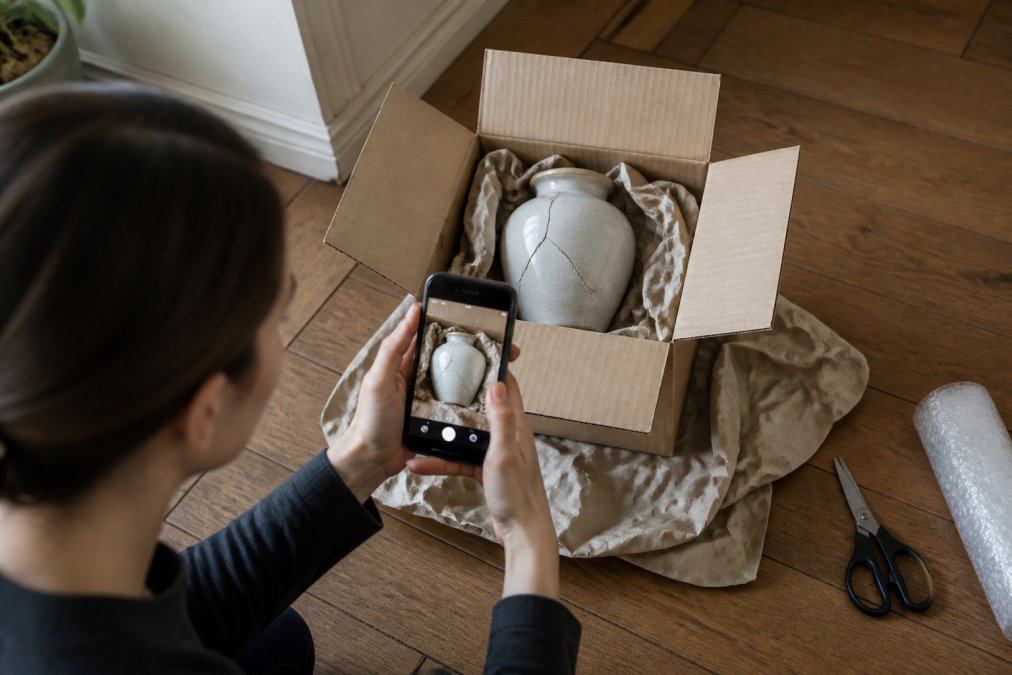
The Evidence File: What to Capture Before You Move Anything
Build the file in this order, before the item leaves the box:
- The sealed box, photograph all six sides with the shipping label legible. Dents, tears, crushed corners, and water stains are the carrier's liability, so capture them in context.
- The opened box, one wide shot showing the item still nested in its packing materials. This proves how it was packed and that you did not repack it.
- The damage close-up, well lit, in focus, from two angles. Include a coin, ruler, or your hand for scale.
- The full item next to the box, establishes that the damaged piece is the one that shipped in that box.
- The shipping label and tracking number, a dedicated close-up, even if it also appears in shot one.
- A 20-30 second video, pan from the sealed box to the opened box to the damage in one continuous take. Video is the hardest evidence to dispute because it cannot be staged after the fact.
The Written Record Most Buyers Skip
Photos win claims, but a written record wins disputes. The same day you find the damage:
- Email customer service rather than calling, so the exchange is timestamped and in writing.
- State the order number, delivery date, item name, and a one-line description of the damage.
- Attach the photos and video in the first message, not a follow-up.
- Ask for a return authorization number and the name of the person handling the claim.
- Save every reply. If the claim is later denied, this thread is what a card issuer reads first.
A common pattern is that buyers who document in writing get a faster resolution than buyers who only call, because the representative can forward a complete file instead of opening an investigation.
When to Keep the Box (and When You Can Toss It)
Keep every box and all packing material until the claim is resolved or the return window closes. Carriers can require a physical inspection, and sellers routinely reject claims where the original packaging is gone. If a carrier schedules an inspection, do not ship the item back first, the inspection happens on the item as received. Once your refund posts, the box is yours to recycle.
The Return Window for Home Decor: What to Expect
The return window for home decor is shorter than most buyers assume. Standard retailers often allow 30 days, but high-end marketplaces frequently require damage claims within 48 hours of receipt (The Expert Marketplace damage claim guidance). That 48-hour clock starts at delivery, not at unboxing.
| Policy Type | Typical Window | What It Covers |
|---|---|---|
| Standard retail return | 30 days | Change of mind, defects |
| Concealed damage claim | 48 hours | Damage hidden until unboxing |
| Final sale / as-is | None | Excluded unless defective |
| Warranty claim | Varies by maker | Workmanship defects |
The lesson: open and inspect decor the day it arrives. Waiting a week to unbox can void your claim before you've even seen the item.
Step-by-Step: How to Return Damaged Home Decor Items
Here is the full sequence for returning damaged home decor items, from first photo to final refund.
- Photograph the box, packaging, and damage before moving anything.
- Contact customer service within the claim window and request a return authorization.
- Submit your photos, order number, and proof of purchase.
- Keep all packaging until the seller confirms the resolution.
- Ship back with the provided return label, or drop off at the designated location.
- Track the return with the tracking number and confirm your refund or replacement.
How to Write a Damaged Item Return Policy Template (For Sellers)
A damaged item return policy template protects both sides: the buyer gets a clear path to a refund, and the seller gets the documentation needed to file a carrier claim. Copy this and adapt it.
Damaged Item Return Policy
- Report damage within 48 hours of delivery with photos of the box, packaging, and item.
- Provide your order number and proof of purchase.
- Keep all original packaging until the claim is resolved.
- Approved claims receive a replacement, refund, or store credit within [X] business days.
- Items marked final sale are excluded unless defective.
A clear policy cuts disputes and speeds up every resolution.
Defective vs. Damaged: Why the Distinction Changes Your Claim
Damaged goods are items harmed in transit or handling after they left the maker. Defective items have a flaw in materials or workmanship that existed before shipping.
The difference decides who pays. Damage claims usually go to the shipping carrier, while defects fall under the manufacturer's warranty. If a lamp arrives with a cracked base, that's transit damage. If the same lamp's switch fails after a week, that's a workmanship defect. Naming the right category in your claim gets it routed correctly the first time.
When the Seller Says No: Escalation Paths That Work
A rejection is not the end. Escalate in order, and keep every step in writing so each level has a paper trail to review.
Step 1: Ask for a Supervisor, Not a Reconsideration
Front-line agents usually work from a script and cannot override a denial. Ask to be transferred to a supervisor or claims specialist, and ask for the denial reason in writing. "Can you email me the reason the claim was denied?" forces the decision into a record you can quote later.
Step 2: Request the Claim in Writing and Re-Submit
Send one concise email that restates the order number, delivery date, damage, and the photos you already provided. Attach the original denial. Ask specifically: which policy clause is being applied, and what documentation would change the outcome. Vague denials often collapse when a buyer asks for the exact rule.
Step 3: File the Carrier Claim Yourself
If the seller blames shipping, you can often open the carrier claim directly with your tracking number, photos, and the original packaging. Carriers generally require the shipper to file, but many will accept a claim from the recipient when the shipper cooperates or is unresponsive. Keep the inspection-ready box until this closes.
Step 4: Dispute the Charge With Your Card Issuer
If the seller still refuses and you paid by credit card, you can dispute the charge. Under the Fair Credit Billing Act, you generally have 60 days from the statement date to dispute a billing error, and damaged or undelivered goods can qualify. Submit your order confirmation, the damage photos, and the full email thread. The FTC's guidance on consumer returns and refunds explains your underlying rights; your card issuer's dispute process is the enforcement mechanism.
Step 5: Escalate to a Consumer Protection Agency
If the dispute fails, file a complaint with your state attorney general's consumer protection division or the Consumer Financial Protection Bureau complaint system. These complaints are routed to the company and often get a response when private emails do not.
Politeness plus documentation beats anger every time.
If you're shopping for decor you can trust to arrive intact, theJoyincolor's accent pillows and hand towels ship with quality and color built in. The Boho Accent Pillow and Salt Marsh Hand Towel are everyday pieces designed to hold up, not just look good in a photo.


Frequently Asked Questions
Can I return a damaged home decor item if I already threw away the box?
Yes, but it is harder. Photographic evidence of the damage itself is the most important proof, and 73% of consumers have returned items due to shipping damage, so most sellers are used to these claims. Without the original packaging, you may need to supply extra photos of the item from multiple angles plus your order number and receipt. Some sellers will still accept the return; others may offer store credit instead of a full refund.
How long do I have to report damaged home decor after delivery?
The return window for home decor varies by seller. Standard online return windows run 14 to 30 days, but high-end marketplaces often require damage claims within 48 hours of receipt. Online return rates for home and furniture items average 18 to 25%, so sellers enforce these deadlines closely. Report damage the same day you open the package, and keep your tracking number and delivery confirmation handy.
Does the seller pay for return shipping on damaged goods?
In most cases, yes. When an item arrives damaged in transit, the cost falls on the seller or the shipping carrier, not you. You should receive a prepaid return label or a drop-off location. If the seller asks you to cover shipping, push back with your photographic evidence and note that the damage occurred before delivery. Escalate to customer service or a manager if the first response is no.
What is the difference between a return and a damage claim?
A return is when you send an item back for a refund, exchange, or store credit, usually because you changed your mind or the item did not match. A damage claim is a formal report that the item was damaged in transit, which may involve the shipping carrier. Damage claims require photographic evidence, the order number, and often a Bill of Lading exception. File a damage claim first if the item arrived broken.
Shipping damage is frustrating, but the return process rewards preparation over patience. Document everything, act inside the window, and escalate with evidence rather than emotion. At theJoyincolor, we build our collection for people who care about color and quality, and we back that with a straightforward shopping experience. Explore the collection and find pieces that arrive ready to live with, not ready to return.