

Table of Contents
- Why Bold Colors Work in Small Apartments
- How to Use the 60-30-10 Color Rule in a Small Space
- Bold Accent Wall Ideas for Small Rooms
- Colorful Home Decor Accessories That Do the Heavy Lifting
- Rental-Friendly Ways to Style Bold Colors
- Choosing Bold Colors for Your Lighting and Room Size
- Conclusion
- Frequently Asked Questions
Last Updated: September 16, 2026
Why Bold Colors Work in Small Apartments
Bold colors in small apartments work because color creates atmosphere that square footage alone cannot. The old rule about painting everything white to make a room feel bigger is losing ground. Design experts and 2026 color collections are moving toward contrasting, atmosphere-driven palettes, according to Style by Emily Henderson and the HGTV Home by Sherwin-Williams 2026 Color Collection. At theJoyincolor, we see the same shift in what customers ask for: rooms that feel intentional, not just spacious.
How to Use the 60-30-10 Color Rule in a Small Space
The 60-30-10 rule splits a room into three shares: 60 percent dominant color, 30 percent secondary color, 10 percent accent. In a small apartment, shrink the dominant share and grow the accent share. A common approach is 50-30-20, which gives bold hues more room to breathe without taking over.
Here's how to apply it:
- Pick a neutral or muted tone for your 50 percent base, such as walls or a large rug.
- Choose a mid-strength color for your 30 percent layer, like a sofa or curtains.
- Reserve the boldest hue for your 20 percent accent, such as pillows, art, or a hand towel.
Bold Accent Wall Ideas for Small Rooms
An accent wall is a single surface painted or covered in a contrasting color to draw the eye. In compact rooms, the best accent wall is rarely the one you'd expect.

Try these instead of the standard feature wall:
- Paint the ceiling in a deep hue and keep walls neutral.
- Use a bold color on the wall behind your bed only, not the whole room.
- Color a single alcove or niche to create a focal point.
- Add a saturated backsplash in a small kitchen.
Colorful Home Decor Accessories That Do the Heavy Lifting
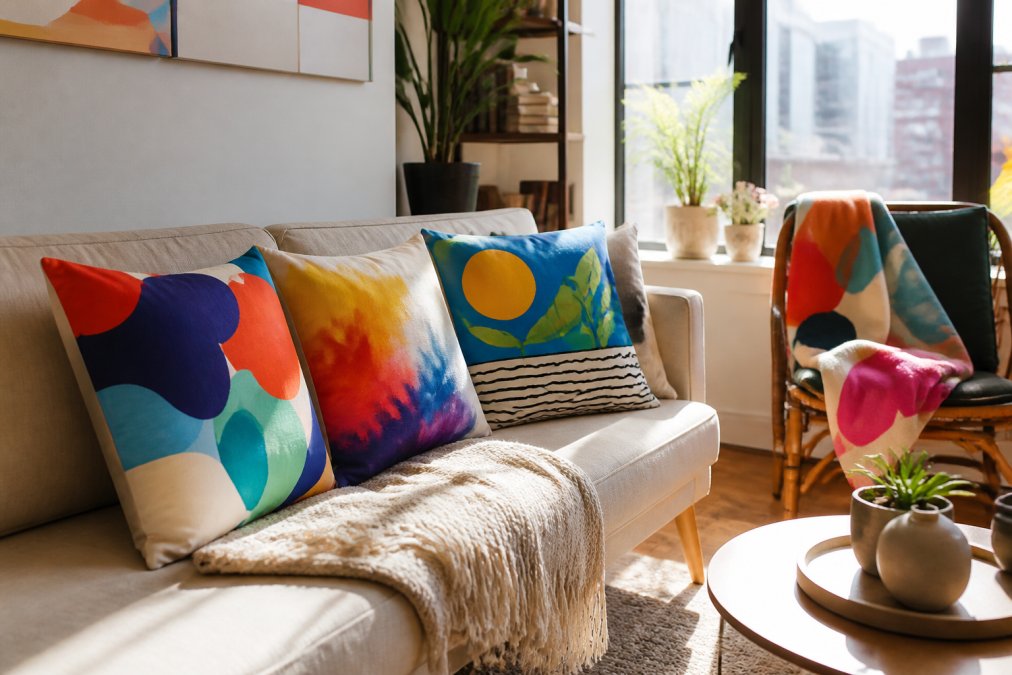
Accessories carry bold color with the least risk, the fastest payoff, and the smallest hit to your budget. Textiles, pillows, and small decor elements let you test a hue before committing to paint, and they move with you when a lease ends. The trick is treating accessories as a system rather than a shopping spree, a few high-impact pieces placed with intent will outperform a room full of scattered color.
Start with the highest-impact, lowest-cost swaps
Rank accessories by how much visual weight they add per dollar spent. In a small apartment, the top of that list is almost always textiles, because they cover large surface areas without requiring a single nail or paint can.
- An area rug. A 5x8 rug in a saturated hue can define a living zone and anchor a bold palette for well under the cost of repainting a room. Choose a flat-weave or low-pile style in a small space so the pattern does not overwhelm the floor plan.
- Curtains. Floor-to-ceiling panels in a bold color draw the eye upward and make low ceilings read taller. Hang the rod close to the ceiling and let the panels just kiss the floor.
- A throw blanket. A chunky knit or woven throw in a jewel tone adds color and texture at once, which matters in compact rooms where every object has to earn its footprint.
- Accent pillows. The simplest way to add a bold hue to a neutral sofa. The Mothers Day Accent Pillow has a machine-washable case and a shape-retaining insert, so it holds up to daily use. The Darkness to Light Accent Pillow works the same way if you want a deeper, moodier palette.
- Small-surface accents. For bathrooms and kitchens, a Salt Marsh Hand Towel adds a vibrant finish to a small surface without repainting anything. A single saturated tea towel, soap dish, or utensil crock can carry a whole corner.
Style accessories in odd-numbered, varied-scale groupings
A common pattern among stylists is to group accessories in threes or fives at different heights and scales. One large pillow, two medium, one small. Matching sizes flatten the effect and make a room look like a showroom rather than a home. Vary the height too, a tall vase next to a low stack of books next to a small ceramic object creates a visual triangle that reads as intentional.


Rotate instead of replace
One advantage of an accessory-led approach is that you can change the room's mood seasonally without buying anything new. Store half your pillows and throws in a closet, swap them out every few months, and the same neutral sofa reads as a different room. This is the cheapest way to keep a small apartment feeling fresh, and it keeps storage needs low because only half the collection is on display at any time.
Budget guardrails
Set a per-piece ceiling before you shop and stick to it. A single statement rug or curtain panel will do more for a small room than five inexpensive tchotchkes, so concentrate your budget on the one or two pieces that cover the most square footage. Thrift stores, estate sales, and clearance sections are reliable sources for bold textiles, and because accessories are non-permanent, a mistake costs you a return rather than a repaint.
Rental-Friendly Ways to Style Bold Colors
Renters can style bold colors without touching a single wall, and in many cases without losing a security deposit. The trick is to treat color as removable. Every method below is reversible, and most cost less than a single can of paint plus supplies.
Removable wallpaper: the highest-impact option
Peel-and-stick wallpaper is the closest thing to painting a wall without painting it. Modern versions use a low-tack adhesive that releases cleanly from most painted drywall, though they can pull at fresh paint, unprimed drywall, or textured surfaces. Test a small square in an inconspicuous spot first, and remove it slowly at a low angle rather than yanking straight out.
- Apply it to one wall, the inside of a closet, or the back of a bookcase rather than a whole room.
- Choose a large-scale pattern in a bold hue so the effect reads from across the room.
- Avoid applying it above a radiator, in a bathroom with poor ventilation, or anywhere steam and heat will loosen the adhesive.
Tension rods and freestanding pieces
Anything that does not require a drill is a renter's friend.
- Bold curtains on a tension rod. A tension rod fits inside a window frame or doorway without screws. Floor-to-ceiling panels in a saturated color add height and drama, and they come down in seconds.
- A folding screen or room divider. A colorful screen can section off a studio sleeping area and introduce a bold hue at the same time.
- Freestanding shelving. A painted or brightly finished bookcase adds color and storage without attaching to the wall.
- An area rug over existing flooring. A rug covers the largest uninterrupted surface in most small apartments and can carry the room's boldest hue.
Swap the small stuff
Cabinet hardware, switch plates, and outlet covers are inexpensive and reversible. A set of saturated cabinet pulls can transform a dated kitchen for the cost of a few hardware pieces and a screwdriver. Store the originals in a labeled bag so you can swap them back at move-out.
Texture does the work color alone cannot
Texture is doing more of this work in 2026. In small apartments, designers are using texture to provide visual interest without the visual chaos of intense color, according to The Colony at Bear Creek's 2026 apartment decorating guide. A chunky knit throw in a bold hue reads as color and softness at once. A woven basket, a nubby upholstery, or a ribbed ceramic vase all add depth that flat color cannot.
What to avoid
Skip anything that requires patching, sanding, or priming. Avoid adhesive hooks on painted walls in humid rooms, and avoid mounting heavy items with removable strips that are rated below the weight of the object. The goal is a room that looks styled, not a move-out dispute.
Choosing Bold Colors for Your Lighting and Room Size
Bold color choice depends on your lighting conditions and room proportions, not just personal taste. A hue that looks rich in a store can turn muddy under warm bulbs or harsh in north-facing light.
Test before you commit:
| Lighting Condition | Best Bold Direction | Avoid |
|---|---|---|
| North-facing, cool light | Warm reds, terracotta, amber | Cool grays, icy blues |
| South-facing, warm light | Cool greens, teals, violets | Heavy oranges |
| Overhead only, dim | Mid-tone saturated hues | Very dark shades |
| Bright, direct sun | Deep jewel tones | Pale pastels |
Conclusion
Styling bold colors in a small apartment comes down to placement, proportion, and pairing. Get those three right and the room feels bigger, not busier.
Frequently Asked Questions
Do bold colors make a small apartment look smaller?
Not necessarily. The old rule that small rooms need light neutrals is being challenged by 2026 design trends. Bold colors can add depth and personality without shrinking the space when you use them strategically. The key is placement: apply saturated hues to horizontal surfaces like floors or ceilings, or limit them to accent pieces and small private rooms like bathrooms. Kropat's interior design work shows that bold color on horizontal surfaces tones down the visual impact in compact spaces, avoiding the overwhelming feeling that vertical wall color can create.
How do I incorporate bold colors into a rental apartment without painting?
Rental-friendly bold styling relies on removable, portable pieces. Start with colorful home decor accessories like accent pillows, hand towels, throws, and art prints. For example, theJoyincolor's accent pillows come in multicolor abstract designs and start at $17.13. You can also use peel-and-stick wallpaper on one wall, large textiles like rugs or tapestries, and removable decals. Group items by color family to create a cohesive look without touching the walls. When you move, everything comes with you.
What is the 60-30-10 rule for interior design?
The 60-30-10 rule is a proportion guideline: 60% of a room uses a dominant color (usually a neutral), 30% uses a secondary color, and 10% uses an accent color. In small apartments, this ratio keeps bold hues from overwhelming the space. For instance, 60% might be white walls and a beige sofa, 30% could be a muted teal rug and curtains, and 10% would be bright fuchsia or turquoise pillows. The rule helps you balance vibrant colors with neutral tones so the result feels intentional, not chaotic.
What are the best bold accent colors for small apartments in 2026?
According to 2026 trend reports, full-bodied reds and unexpected violets are leading interior color choices. Specific bright accents gaining traction include Alexandrite, Lava Falls, Turquoise, Fuchsia, Mint, and Aqua, often paired with neutral tones like White Onyx for balance. These hues work well as accent wall colors or on decor elements. The HGTV Home by Sherwin-Williams 2026 Color Collection of the Year emphasizes contrasting palettes that feel both bold and calming, giving you a framework for mixing these shades in compact spaces.
Small spaces reward bold choices made with care. At theJoyincolor, we make that easier with accent pillows, hand towels, and decor pieces built to bring vibrant color into everyday rooms. Browse the collection and find the pieces that make your apartment feel like yours.