

Table of Contents
- What Professional Home Styling Actually Delivers in a Small Home
- What Does the Cost of Professional Home Styling Look Like?
- The ROI Data: When Staging Pays Off and When It Doesn't
- Small Space Interior Design Tips That Do the Heavy Lifting
- Modern Aesthetic Home Decor for Beginners: DIY vs. Professional
- Virtual Staging and Budget Alternatives for Small Homes
- How to Decide If Professional Styling Is Worth It for Your Small Home
- Frequently Asked Questions
Last Updated: September 30, 2026
What Professional Home Styling Actually Delivers in a Small Home
Professional home styling is the paid service of arranging furniture, decor, and lighting so a property photographs well and appeals to buyers. In a small home, every piece must earn its floor space.
The Difference Between Staging and Styling
Staging prepares a home for sale: depersonalization, decluttering, and furniture rental aimed at the widest buyer pool. Styling is lighter and more personal, keeping your furniture and layering in texture, color, and accessories to make a lived-in space look intentional. Staging is a temporary investment tied to a listing date; styling is something you keep.
Why Square Footage Changes the ROI Math
In a large home, a stager can add a console table nobody needed and the room still breathes. In a small home, one wrong piece shrinks the room, so professional judgment is worth more per square foot, even though the total bill is lower.
- Large home: staging cost spread across many rooms, errors absorbed by space
- Small home: every piece is visible, so proportion and scale decide the outcome
What Does the Cost of Professional Home Styling Look Like?
The average cost to stage a house is $995, according to Zillow's home staging cost analysis. Small homes usually land at the lower end, since pricing scales with square footage and room count. A single-room styling consultation often runs a few hundred dollars, while full furniture rental for a vacant small home can run higher than the staging itself.
| Service | Typical Scope | Cost Range | Best For |
|---|---|---|---|
| Styling consultation | 2-hour walkthrough, written plan | $150-$400 | Occupied small homes |
| Partial staging | 2-3 rooms, accessories only | $400-$800 | Condos under 1,000 sq ft |
| Full staging | Furniture rental, all rooms | $995+ | Vacant listings |
| Virtual staging | Digital furniture added to photos | $20-$100 per photo | Budget listings |
Line-Item Breakdown of Typical Styling Services
Most quotes break into four parts: design fee, furniture rental, accessories, and removal. Removal is the line sellers forget, rental furniture must leave before closing, and that pickup is billed.
The ROI Data: When Staging Pays Off and When It Doesn't
Homeowners who professionally stage before listing see an average return on investment of 5% to 15%, per The Zebra's home staging statistics. Set against that $995 average cost, the math works out in most cases, but not all of them.
Small Space Interior Design Tips That Do the Heavy Lifting
Small space interior design tips that move the needle come down to three things: scale, light, and restraint. Get those right and a small room reads as intentional rather than cramped.
Furniture Scale and Proportion in Compact Rooms
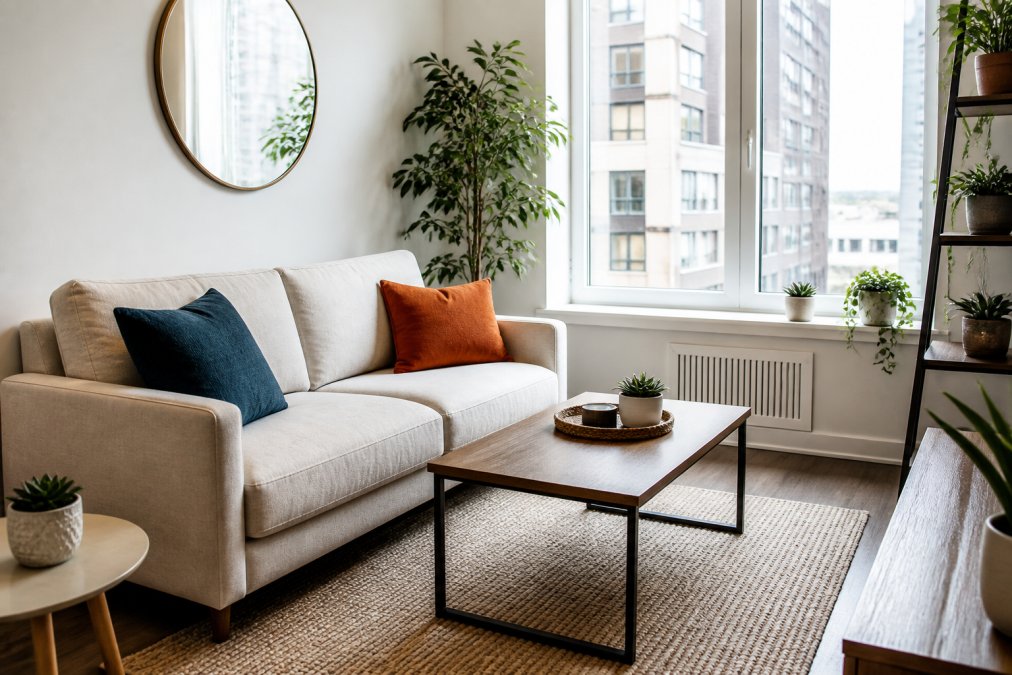
Measure the room before you buy anything. A sofa should take up no more than two-thirds of the wall it sits against, and rugs should be large enough that at least the front legs of your seating rest on them, a too-small rug makes a room look smaller, not bigger. A few well-chosen pieces beat a full set.
Modern Aesthetic Home Decor for Beginners: DIY vs. Professional
Modern aesthetic home decor for beginners is achievable without a designer: pick a neutral base and add color in two or three places only. That keeps a small space coherent and costs far less than a styling fee. But the DIY-versus-professional question isn't about skill, it's about which failure mode you can afford. In a small home, a wrong decision is visible from every seat.
When DIY Actually Wins
DIY wins in three specific scenarios:
- You already own furniture that fits the room's proportions. If your sofa, rug, and main seating are correctly scaled, you're decorating, not staging, accessories and lighting are enough.
- You're staying in the home. Styling is a permanent improvement, not a listing expense, so you're buying daily enjoyment, not a faster sale.
- You have a clear reference. One saved photo of a room with similar square footage and ceiling height gives you a target; without one, DIY drifts toward accumulation.
When Professional Styling Wins
Professional styling wins when the home is vacant, when listing photos are the primary sales tool, or when the seller has lived there long enough to stop seeing it. The last case is more common than people admit: a stylist walks in cold and immediately spots the oversized sectional, the rug two feet too small, and the wall of framed photos that makes a 12-foot wall feel like 8.
The Hybrid Approach Most Small-Home Owners Should Use
The highest-return path for a small home is rarely all-DIY or all-professional, it's a paid consultation followed by DIY execution. A two-hour walkthrough with a written plan costs a few hundred dollars and gives you the one thing DIY can't: an outside read on what's actually wrong. You then execute it yourself over a weekend, buying only what the plan calls for.
What Beginners Get Wrong
The most common beginner mistake in a small home is treating empty surface area as a problem to solve. Every horizontal surface, coffee table, console, nightstand, counter, collects objects unless you decide in advance what belongs there. A stylist's rule of thumb is one object per surface plus one functional item: a lamp and a small tray, a candle and a book. Not a collection.
Virtual Staging and Budget Alternatives for Small Homes
Virtual staging is the cheapest way to test whether styling helps your listing. It adds digital furniture to photos for roughly $20 to $100 per image, a fraction of physical staging. It won't help buyers standing in the room, but it improves click-through on the listing itself.
Two other budget options:
- Partial staging: style only the rooms that appear in listing photos
- Accessory-only styling: keep your furniture, swap pillows, towels, and table linens
How to Decide If Professional Styling Is Worth It for Your Small Home
Professional home styling worth the fee for a small home when the property is vacant, sitting on the market, or has flat listing photos. It's usually not worth it when you're staying put and already own furniture that fits. But the general ROI figures on real estate portals, the 5% to 15% average return, the faster-days-on-market claims, were calculated across homes of all sizes.
Why the Small-Home ROI Math Is Different
The first bend: your absolute staging cost is lower. A 900-square-foot condo needs less furniture rental, fewer accessories, and less stylist time than a 3,000-square-foot house, so the same percentage return produces a smaller dollar figure, but the break-even point is lower too. A $600 staging bill on a $300,000 condo is 0.2% of the sale price; the same bill on a $900,000 house is 0.07%.
The Clutter Mechanism Nobody Explains
Here's the psychological piece most guides skip. In a large room, clutter reads as a lifestyle; in a small room, it reads as a storage problem. Buyers walk into a 700-square-foot condo, see mail on the counter and a chair piled with clothes, and their brain registers "no closets," not "messy person." That inference happens in seconds and is nearly impossible to undo.
The Virtual Staging Option Competitors Barely Mention
If you're not sure styling will move your listing, virtual staging is the cheapest way to test it. It adds digital furniture to your existing photos for roughly $20 to $100 per image, a fraction of physical staging. It won't help buyers standing in the room, and disclosure rules in most markets require you to label virtually staged photos, check with your agent.
The Decision Checklist
Run this before you book anyone:
- Is the home vacant? Vacant small homes photograph poorly and benefit most from physical staging
- Has it been listed more than 30 days without an offer?
- Do your listing photos look cluttered or dark?
- Does your furniture fit the room's proportions, or does it merely fit through the door?
- Can you cover the cost without needing the full premium back?
- Have you asked a local agent what's normal in your market?
- Have you tested virtual staging on your main living area first?
Tick three or more of the first five and professional styling is likely to pay for itself. Tick fewer and start with accessories and a styling consultation before committing to full staging. If the home is occupied and your furniture already fits, the highest-return move is a two-hour consultation plus a weekend of DIY execution, you capture the outside judgment without paying for furniture rental, delivery, or pickup.
For small homes, the highest-return move is rarely full staging. It's fixing proportion and clutter first, then adding a small number of strong accents. Test with virtual staging before you spend on physical staging, and remember that in a compact room, the buyer's first inference is about storage, not style.
Frequently Asked Questions
What are the primary benefits of professional styling for small square footage?
Professional styling helps buyers see how a compact layout can work for daily life. According to the National Association of Realtors, 83% of buyers' agents say staging makes it easier for clients to visualize a property as their future home. For small homes, a stylist addresses furniture scale, visual clutter, and flow, which are the exact issues that make tight spaces feel smaller than they are.
How much does professional home styling typically cost?
Zillow reports the average cost to stage a house at $995, though small homes often cost less because fewer rooms and pieces are involved. A styling consultation alone may run lower, while full furniture rental and installation push the number higher. Homeowners who stage typically see a 5-15% return on investment, according to The Zebra, so the spend often recovers itself at closing.
Can professional styling make a small room look larger?
Yes, and the effect comes down to furniture scale and spatial planning. A stylist removes oversized pieces, opens walking paths, and uses a neutral color palette to reduce visual clutter. Part of the premium comes from buyers perceiving compact rooms as functional rather than cramped.
Is it worth hiring a stylist if I am not selling my home?
It can be, but the ROI math changes. Without a sale, you are investing in daily enjoyment rather than a higher selling price. A middle path works well: hire a stylist for a one-time consultation to get a layout and color plan, then buy pieces yourself. Affordable accents like the Mothers Day Accent Pillow at $17.13 let you test a look before committing to larger furniture purchases.
What is the difference between home staging and interior styling?
Home staging prepares a property for sale, using depersonalization and neutral choices to help buyers imagine themselves in the space. Interior styling shapes a home for the people already living in it, so personal color and character stay in. For small homes, staging tends to focus on clearing visual clutter and maximizing perceived square footage, while styling focuses on making every square foot work for your routine.