

Table of Contents
- Why Functional Home Decor Matters More Than Ever
- Step 1: Define How Your Space Actually Works
- Step 2: How to Evaluate Quality in Home Decor Before You Buy
- Step 3: Best Materials for Long-Lasting Home Accessories
- Step 4: Functional Decor Ideas for Small Spaces
- Step 5: Mixing Practicality With Personal Style
- Common Mistakes to Avoid When Buying Decor
- Conclusion: Build a Space That Works for You
- Frequently Asked Questions
Last Updated: September 9, 2026
Why Functional Home Decor Matters More Than Ever
The global home decor market is valued at USD 258.1 billion in 2026, with a projected compound annual growth rate of 6.9% through 2036 (Future Market Insights home decor market analysis(https://www.futuremarketinsights.com/reports/home-decor-market)). The common thread across 2026 design trends is a shift toward "fewer pieces, better choices," emphasizing quality and durability over quantity (Decorating and More 2026 trend observations(https://www.facebook.com/groups/decoratingandmore/posts/3994069050899690/)).
At theJoyincolor, we believe functional home decor is the answer to a simple problem: buying pieces that look stunning but fail to serve your daily life. This guide walks through practical steps for choosing pieces that earn their place in your home, evaluating quality, selecting durable materials, and designing for small spaces without sacrificing personality.
Step 1: Define How Your Space Actually Works
Before shopping, map how you live in each room. Functional home decor starts with an honest look at your daily patterns, not a Pinterest board. Walk through your space and note where you sit, where you drop keys, and which surfaces gather clutter.
Ask yourself three questions:
- What activities happen here daily?
- Which pieces would make those activities easier?
- What currently gets in the way?
Interior design in 2026 is shifting toward clarity and warmth, with layouts that are easy to understand and tactile materials that invite touch (Reimagine Home 2026 interior design trends(https://www.reimaginehome.ai/blogs/top-interior-design-trends-2026)). A layout that works for your actual routine matters more than following a trend. For example, if you eat dinner on the couch nightly, a sturdy coffee table at the right height beats a delicate accent table.
Step 2: How to Evaluate Quality in Home Decor Before You Buy
Quality evaluation comes down to construction details you can check in minutes. Look at seams, joints, and hardware before considering color or pattern.
Furniture accounts for 42% of the home decor product type market share in 2026, confirming it as the primary functional investment consumers make (Future Market Insights product type breakdown(https://www.futuremarketinsights.com/reports/home-decor-market)). Since furniture dominates spending, learning to assess it matters most. Check drawer slides, test stability, and examine fabric weave density.
Machine-washable covers and removable inserts are practical signals of good design. When evaluating accent pillows, look for hidden zippers and shape-retaining inserts that survive regular use.

Step 3: Best Materials for Long-Lasting Home Accessories
Most decor guides stop at “choose wood or linen.” But the real question is: which material survives your household, dogs, kids, red wine, direct sunlight, or all of the above?
The Durability Stress Test
Before buying any piece, run it through a quick mental stress test based on your home’s top three risks:
| Household Stressor | Best Material Choices | Materials to Avoid | Why It Matters |
|---|---|---|---|
| Pets (claws, fur, accidents) | Performance polyester, crypton, leather, tightly woven wool | Loose-weave linen, silk, velvet | Pet claws snag loose weaves; performance fabrics resist punctures and are wipe-clean |
| Young children (spills, crayons, jumping) | Coated canvas, microfiber, solid wood with sealed finish | Unsealed porous stone, light-colored cotton | Sealed surfaces prevent liquid absorption; dark or patterned fabrics hide stains between washes |
| Direct sunlight (fading) | Solution-dyed acrylic, polyester, treated woods | Natural dyes, unprotected linen, unfinished oak | UV light breaks down natural fibers and dyes; solution-dyed fibers have color throughout, not just on the surface |
| High-traffic seating (daily use) | High-density foam (1.8-2.5 lb/ft³), kiln-dried hardwood frames | Low-density foam, particleboard frames | High-density foam holds shape; kiln-dried hardwood resists warping and joint failure |
Maintenance Realities: What You’ll Actually Do Weekly
The biggest hidden cost of decor isn’t the price tag, it’s the upkeep:
- Wood: Sealed wood needs only occasional dusting and a yearly conditioning with a beeswax-based polish. Unsealed wood requires monthly oiling and stains easily. Always ask: Is this piece pre-sealed?
- Linen: Pure linen wrinkles, fades in direct sun, and shows every drop of water. A linen-cotton or linen-polyester blend (60/40 or higher polyester) keeps the look but survives machine washing. Check the care label before you fall in love.
- Ceramics: Glazed ceramic is dishwasher-safe and stain-resistant. Matte or unglazed finishes absorb oils and require hand washing. For everyday tableware, choose a high-gloss glaze, it hides less but cleans faster.
- Performance fabrics: Look for terms like “solution-dyed” or “stain-resistant finish.” These indicate the fiber itself is colored (so fading is less visible) or treated with a protective coating. A good performance fabric should have a rub count (Martindale) of 30,000+ for residential use.
The Specs That Actually Predict Longevity
When shopping online, you can’t touch the fabric. But you can check three numbers that separate durable pieces from disposable ones:
- Fabric weight (oz./yd.² or g/m²): For upholstery-weight textiles, look for 12 oz./yd.² (400 g/m²) or higher. For pillows and throws, anything under 7 oz./yd.² (240 g/m²) will feel thin and pill within months.
- Martindale rub count: This measures abrasion resistance. Residential sofas should have 20,000-30,000 rubs; if a product page doesn’t list it, email the seller. A count under 15,000 is for decorative pieces only.
- Foam density (for cushions): Expressed in lb/ft³. Low-density foam (under 1.5) loses shape in 1-2 years. High-resilience foam (2.0+) holds up for 5+ years with regular flipping.
The Trade-Off Framework
No material is perfect. The functional choice is about accepting the right trade-off for your situation:
- Leather vs. performance fabric: Leather develops a patina and is easy to wipe clean, but scratches from pet claws are permanent. Performance fabric hides scratches but may pill in high-friction areas.
- Solid wood vs. veneer: Solid wood can be refinished if damaged; veneer cannot. But veneer is often more stable in humid climates (less warping). For a child’s room, a high-quality veneer on a solid core may outlast solid wood that gets banged up.
- Natural stone vs. ceramic: Stone (marble, granite) is porous and needs sealing every 6-12 months. Ceramic with a full glaze is maintenance-free. If you won’t reseal stone on schedule, choose ceramic.
The 10-Second In-Store Test
If you’re shopping in person, run this quick check before committing:
- Scratch the fabric with a fingernail. Does it snag? If yes, it won’t survive pets or kids.
- Press your palm into a cushion. Does it spring back immediately? Slow recovery means low-density foam.
- Tap wood surfaces. Does it sound solid or hollow? Hollow indicates particleboard or thin veneer.
- Check seams and corners. Are they reinforced with double stitching? Single stitching fails first.
Step 4: Functional Decor Ideas for Small Spaces
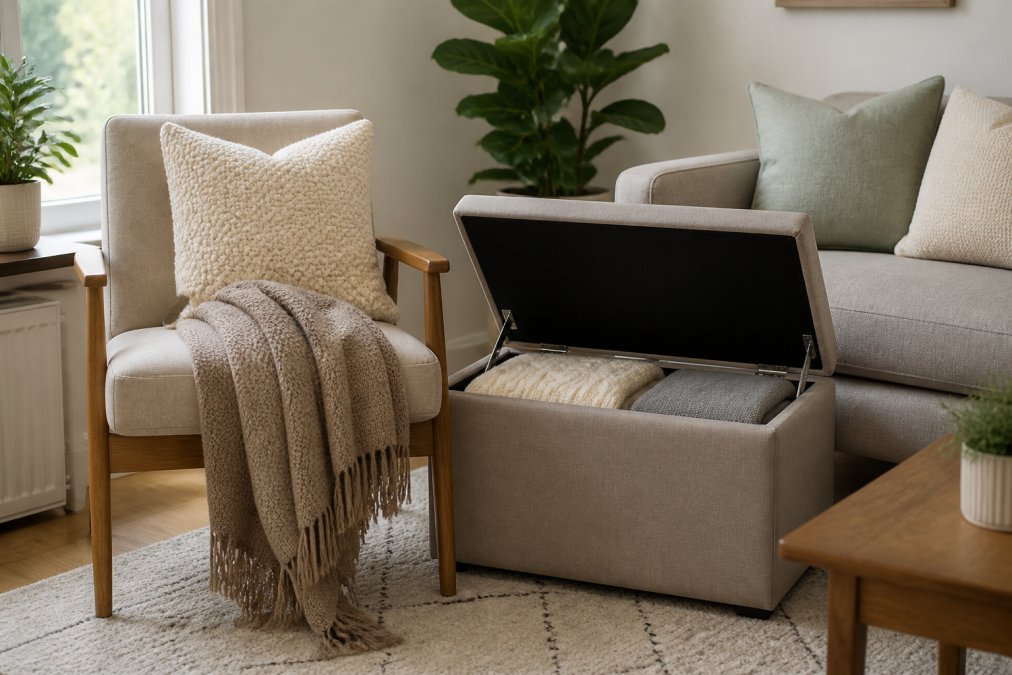
Small-space decor fails in one of two ways: either you buy too much and crowd the room, or you buy too little and lose functionality. The fix isn’t “minimalism”, it’s layered multi-functionality. Every piece should earn its square footage by serving at least two distinct purposes.
The Dual-Purpose Furniture Framework
Before buying anything for a small room, ask: What are the two jobs this piece will do? If you can’t name two, it doesn’t belong.
| Piece | Primary Function | Secondary Function | What to Check Before Buying |
|---|---|---|---|
| Storage ottoman | Footrest / extra seat | Hidden storage for blankets, toys, or books | Hinged lid stays open on its own; weight capacity (most hold 250-300 lbs); fabric is stain-resistant |
| Wall-mounted drop-leaf desk | Workspace | Dining surface or craft station when folded | Mounting hardware rated for the wall type (drywall vs. stud); leaf locks securely; depth when open fits your chair |
| Nesting side tables | Surface for drinks/books | Extra seating or display pedestals when separated | Smaller table fits fully under larger; both are stable when separated; height difference is usable (not just decorative) |
| Sofa bed (modern click-clack) | Couch for lounging | Guest bed | Mechanism operates smoothly without tools; mattress thickness (4-6 inches is minimum for comfort); frame is steel or kiln-dried hardwood |
| Storage bench | Entryway seating | Shoe or gear storage | Seat height is comfortable (17-19 inches); lid is damped (won’t slam); interior is ventilated to prevent odors |
The 3-Zone Rule for Small Rooms
A small space feels cramped when everything is pushed against the walls. Divide the room into three functional zones:
- The Seating Zone: A loveseat or two chairs + a slim console table behind for drinks and decor. Skip the oversized sofa, it eats floor space and makes the room feel like a waiting room.
- The Work Zone: A wall-mounted desk (12-16 inches deep when open) with floating shelves above for supplies. When closed, it disappears into the wall.
- The Storage Zone: A tall, narrow bookcase or cabinet (under 24 inches wide) that uses vertical space. Choose one with closed lower cabinets to hide clutter and open upper shelves for display.
Vertical Storage: The Most Underused Square Footage
The average small room has 8-10 foot ceilings, but most decor stops at 4 feet. Vertical storage doubles your functional space without adding floor coverage:
- Floor-to-ceiling shelving: A unit that runs from floor to ceiling (anchored to the wall) adds 3-4x the storage of a standard bookcase. Use lower shelves for heavy items, upper shelves for light decor.
- Over-door organizers: The back of a closet or bedroom door holds shoes, accessories, or cleaning supplies without taking any floor space.
- Magnetic strips: On kitchen walls or inside cabinet doors, they hold knives, spice jars, or tools, freeing up drawer space.
- Corner shelving: Triangular or curved shelves fit into dead corners that rectangular furniture can’t use. A corner shelf unit can add 4-6 cubic feet of storage in an otherwise wasted spot.
The Measurement Protocol That Prevents Disaster
Most small-space buyers never see the piece in person. Before you click “buy,” run this five-step measurement check:
- Measure the floor footprint (length × width) and mark it with painter’s tape on your floor. Live with the tape outline for 24 hours. If you trip over it or feel crowded, the piece is too big.
- Measure the path from the door to the spot. A piece that fits in the room may not fit through the hallway or stairwell. Check both width and height of every doorway.
- Measure the wall height for anything wall-mounted. Standard ceilings are 8 feet; a tall bookcase needs 6-12 inches of clearance from the ceiling for installation.
- Check the “clearance zone.” For a storage ottoman, you need 18 inches of walking space around it. For a desk chair, you need 36 inches behind it to push back.
- Photograph the space with a tape measure visible in the frame. When you’re shopping online, pull up that photo and compare proportions before ordering.
The Trade-Offs of Multi-Functional Furniture
Dual-purpose pieces aren’t perfect. Understanding the trade-offs helps you choose wisely:
- Storage ottomans hide clutter but often have thin padding, uncomfortable for long sitting. Look for one with a flat, firm top that works as a coffee table surface.
- Sofa beds are heavier and harder to move than regular sofas. The mechanism adds 20-40 lbs. If you move frequently, a high-quality futon on a solid wood frame may be more practical.
- Drop-leaf desks save space but have less surface area than a standard desk. If you need a permanent dual-monitor setup, this won’t work, choose a narrow but full-time desk instead.
- Nesting tables are versatile but can look cluttered when separated. If your style is minimalist, a single large ottoman with a tray top may serve better.
The 80/20 Rule for Small-Space Decor
In a small room, 80% of your pieces should be strictly functional (storage, seating, surfaces), and only 20% should be purely decorative. That doesn’t mean 80% of your room is ugly, it means the decorative 20% gets to shine because it isn’t competing with clutter.
Apply this rule when shopping: for every purely decorative item you want to buy, find one functional item that also brings you joy. A beautiful ceramic bowl that holds keys is better than one that sits empty.
Step 5: Mixing Practicality With Personal Style
Your space should tell your story while working hard. Functional home decor does not mean sterile or boring. The 2026 design focus on "personal storytelling" confirms that homes should reflect who lives there, not just follow a catalog look (Reimagine Home 2026 design philosophy(https://www.reimaginehome.ai/blogs/top-interior-design-trends-2026)).
Choose a color scheme that energizes you, then apply it through accent pieces that serve a purpose. A vibrant throw pillow adds personality to a neutral sofa. A colorful hand towel brings life to a bathroom while doing its job.
The theJoyincolor approach centers on vibrant, thoughtfully designed pieces that work in real homes. Our accent pillows feature machine-washable cases and shape-retaining inserts, so bold color comes with everyday practicality. The Salt Marsh Hand Towel pairs a soft polyester front with an absorbent white cotton back, proving that style and function coexist.

Common Mistakes to Avoid When Buying Decor
Most purchasing mistakes trace back to prioritizing aesthetics over daily needs. Decor that prioritizes style over function often fails to serve the user, leading to cluttered or impractical living spaces (EXTERNAL_LINK: About Wall Art functional design critique | aboutwallart.com). Here are the pitfalls we see most often:
- Buying trend pieces over timeless ones. Trends fade; your daily life does not.
- Ignoring scale and proportion. A giant vase on a slim shelf looks wrong and wastes space.
- Choosing hard-to-clean materials. White linen in a high-traffic area creates stress.
- Skipping ergonomics. A beautiful chair that hurts your back is not functional.
- Over-accessorizing. Too many decor accessories create visual noise, not warmth.
Ergonomics in home decor means choosing furniture that supports your body correctly. Desk chairs need proper lumbar support. Sofas should have seat depth that suits your height.
Conclusion: Build a Space That Works for You
Functional home decor is not about compromise; it is about making intentional choices that serve both your eyes and your daily routines. Start with how you live, evaluate quality carefully, choose durable materials, and let your personality show through practical pieces.
At theJoyincolor, we curate products that bring vibrancy to daily life without sacrificing utility. Our accent pillows and hand towels are designed for real homes, with machine-washable materials and quality construction. Get started with theJoyincolor and build a space that works as hard as you do.
Frequently Asked Questions
How do you balance aesthetics and functionality in home decor?
Start with how you use the room, then choose pieces that serve that purpose. A beautiful coffee table is functional if it has storage for remotes and coasters. A vibrant accent pillow earns its place when it is also machine-washable for everyday use. Test each item against your daily routine. If it only looks good but creates clutter or requires constant care, it fails the functional test, no matter how stylish it appears.
What are the best materials for durable home decor?
Look for tightly woven fabrics like polyester blends for pillows, which resist fading and hold their shape. For textiles, check the fabric weight; heavier weights around 400 g/m² indicate better durability. Solid wood and stone last for decades, while ceramics add a tactile, lasting finish. Avoid flimsy plastics and thin, low-thread-count fabrics that pill or tear within months of regular use.
How do you determine the quality of home decor before buying?
Check the product specifications for material composition and construction details. A hidden zipper on a pillow case, for example, shows more careful manufacturing than a visible one. Look for machine-washable care instructions, which simplify maintenance. Read the fabric weight and consider whether the insert is shape-retaining. These details tell you whether a piece will survive daily use or end up in a donation pile within a year.
What is the best way to choose functional decor for a small space?
Prioritize multi-functional pieces that serve more than one purpose. Choose furniture with built-in storage, wall-mounted shelves to free up floor space, and textiles that add warmth without taking up room. Use accent pillows and throws to introduce color and texture, since they are easy to swap seasonally. Measure your space first and keep a clear floor plan so every item you bring in has a defined job and a clear place.