

Table of Contents
- What the 3-5-7 Rule in Decorating Actually Means
- How the 3-5-7 Rule Relates to the Rule of Three and Rule of Odds
- When to Use Three, Five, or Seven Objects
- 3-5-7 Decorating Rule Examples for Real Rooms
- How to Style a Shelf With Decor in Five Steps
- How to Arrange Objects on a Coffee Table Without Clutter
- Common Mistakes That Break the 3-5-7 Rule
- Conclusion: Start With Three, Then Build
- Frequently Asked Questions
Last Updated: October 5, 2026
What the 3-5-7 Rule in Decorating Actually Means
The 3-5-7 rule in decorating says you should group decorative objects in odd numbers, usually three, five, or seven, to create balance and visual interest.
Why odd numbers? A pair creates a mirror: your eye bounces between the two and stops.
Designers have leaned on this idea for decades, and it shows up in interior design resources from the Smithsonian and countless styling guides.
How the 3-5-7 Rule Relates to the Rule of Three and Rule of Odds
The 3-5-7 rule is a specific version of the rule of odds, which says odd-numbered groups look better than even ones. The rule of three is the smallest version: three objects, one focal point, two supporting pieces.
Think of it as a family:
- Rule of odds: any odd number works (three, five, seven, nine)
- Rule of three: the simplest, cleanest version
- 3-5-7 rule: a practical range for real surfaces
The 3-5-7 rule tells you where to stop: past seven objects, a group reads as clutter.
When to Use Three, Five, or Seven Objects
The number of objects should match the size of the surface and the look you want. A small side table cannot hold seven pieces; a long mantel looks empty with three.
Here is a quick way to decide:
| Surface | Object Count | Best For |
|---|---|---|
| Side table, nightstand | 3 | Clean, calm look |
| Console, coffee table | 5 | Layered interest |
| Mantel, long shelf | 7 | Full, collected display |
Three Objects: Small Surfaces and Clean Looks
Three objects suit small surfaces and minimal rooms. Use one tall, one medium, and one small piece, a vase, a stack of two books, and a small bowl is a complete vignette. Keep the color scheme tight so the group reads as one unit.
Five Objects: Medium Surfaces and Layered Interest
Five objects give you room to layer. Mix heights and textures so the group does not flatten out, making all five the same size is a common mistake.
Seven Objects: Large Surfaces and Full Displays
Seven objects fill a large surface without tipping into clutter. Use them on a mantel, long console, or big shelf, grouped in two or three small clusters rather than one long row so the eye keeps moving.
3-5-7 Decorating Rule Examples for Real Rooms
A few concrete setups make the rule easier to picture.
Living room coffee table (five objects):
- A stack of three books
- A ceramic bowl on top of the stack
- A small plant
Bedroom nightstand (three objects):
- A lamp
- A small vase with one stem
- A single book
Entryway console (seven objects):
- Two book stacks
- A tall vase
- A small tray
Fireplace mantel (seven objects):
- A large mirror or frame as the anchor
- Two candlesticks
- Two small plants
The pattern holds across every room. Odd numbers, mixed heights, one clear focal point.
How to Style a Shelf With Decor in Five Steps
Styling a shelf comes down to five steps: clear it, pick a focal point, group in odd numbers, vary height and texture, then step back and edit. Most people skip the last step, which matters most. This sequence works on a single floating shelf or a full built-in.
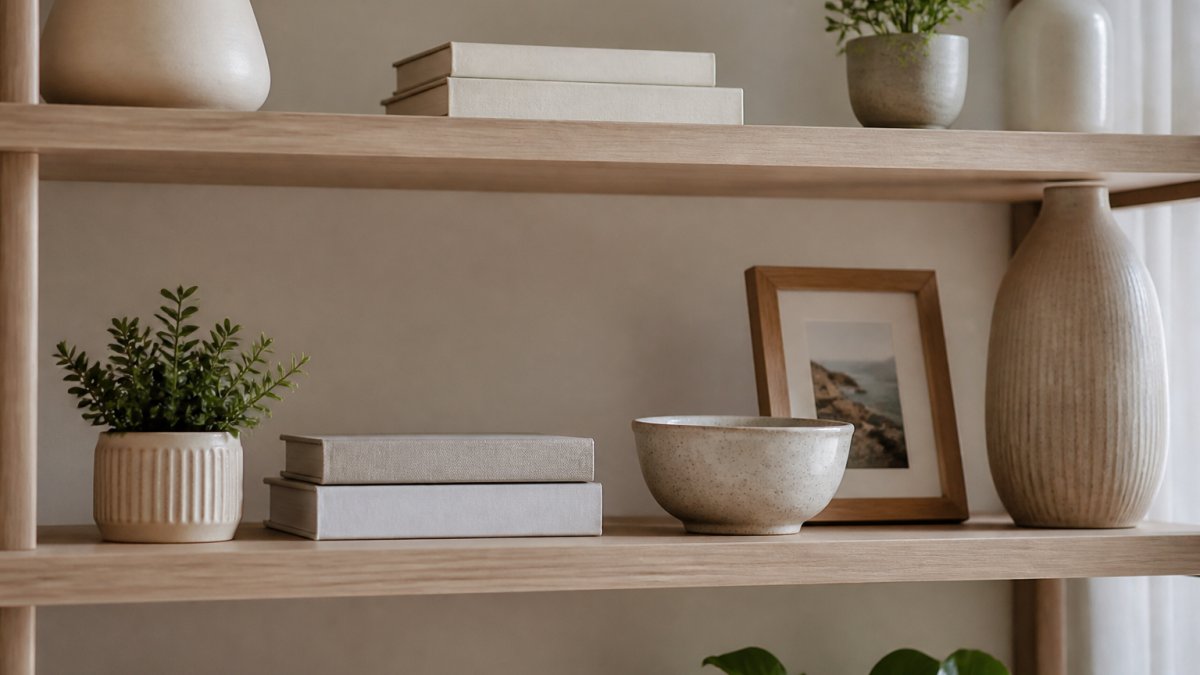
Step 1: Clear the Shelf Completely
Take everything off and wipe the surface. Starting from zero is the only way to see the shelf's real proportions, depth, height clearance, and how much visual weight it can carry. A shelf that looked full often looks enormous when empty, telling you it can hold five or seven pieces rather than three.
Step 2: Choose One Focal Point
Pick a single anchor object: a large vase, framed art, a mirror, or a substantial sculpture. The eye lands on it first, and everything else supports it. On a narrow shelf, keep the anchor no taller than about two-thirds of the clearance above so it does not crowd the shelf above.
Step 3: Group in Odd Numbers
Build the arrangement in threes, fives, or sevens, never a single even row. On a standard 36-inch shelf, three read as calm and minimal, five as collected and layered, seven as full and curated. Under 24 inches, stay at three; on a built-in run of 48 inches or more, five or seven keeps it from looking sparse.
Step 4: Vary Height, Shape, and Texture
This is where most shelves go flat. Mix tall with short, round with square, smooth with rough. A reliable pattern is tall-medium-small repeated across the shelf, with the tallest piece off-center. Lean a framed print against the back wall, stack two or three books horizontally as a riser, and set a small object on top for a third height level.
Step 5: Step Back and Edit
Walk at least six feet back, or take a photo. Remove one object; if the shelf still looks good, leave it out. Then check: Is there a clear focal point? Does the eye travel instead of stopping? Is at least a quarter of the surface still visible? If any answer is no, remove another piece or shift the anchor.
How to Decide Between Three, Five, and Seven on a Shelf
The number should follow the shelf, not the other way around:
| Shelf width | Object count | Why |
|---|---|---|
| Under 24 inches | 3 | Anything more crowds the edges |
| 24-48 inches | 5 | Room for layering without clutter |
| Over 48 inches | 7 | Fills the run and keeps the eye moving |
Scale matters as much as count: three large objects can fill a long shelf, and seven tiny ones can leave it bare. Judge by total footprint, not the tally.
Common Shelf Mistakes and How to Fix Them
- Everything the same height. Fix it by stacking books under one or two pieces to create a riser.
- Objects pushed to the back wall. Pull the group forward so the front edge of the shelf has breathing room.
- A row of identical bookends. Break the symmetry by mixing a vertical book stack with a horizontal one.
How to Arrange Objects on a Coffee Table Without Clutter
Arranging objects on a coffee table without clutter means using fewer pieces than you think and keeping roughly one third of the surface clear. Five objects is the sweet spot for most tables, but how you distribute visual weight matters more than the count.
Use the Rule of Thirds as a Layout Tool
Picture the tabletop split into three zones, left, center, right. Put your main group in one, a smaller secondary group in another, and leave the third open; that open space makes the arrangement feel calm. A common pattern: anchor group on the left, small stack or tray on the right, center open for a drink, book, or remote.
Match the Group to the Table Size
A coffee table too small for five objects will look cluttered no matter how well you style it. Start here:
| Table size | Object count | Notes |
|---|---|---|
| Small (under 36 inches) | 3 | One anchor plus two small pieces |
| Standard (36-48 inches) | 5 | One main group plus one secondary group |
| Large (over 48 inches) | 5-7 | Split into two or three clusters, not one long row |
Scale is the tiebreaker: three large objects, a big bowl, tall vase, thick book stack, can fill a standard table, while seven small ones can look scattered.
Build the Arrangement in This Order
- Place the anchor first. A tray, a large bowl, or a substantial vase. This sets the visual weight.
- Add a height element. A vase with stems, a small plant, or a candlestick. Keep the tallest object off-center.
- Add a horizontal element. A stack of two or three books, laid flat, gives the eye a rest and a surface for a small object on top.
- Add one texture contrast. A woven tray, a rough ceramic, or a piece of greenery against smooth surfaces.
- Add one functional piece. A candle, a small bowl for keys, or a coaster set, something you actually use.
- Step back and remove one thing. If the table still looks good, leave it out.
Keep the Table Usable
Practical use matters as much as looks. A coffee table you cannot set a mug on is staged, not styled. Follow these rules:
- Keep the tallest object off-center so it does not block sightlines across the room.
- Use a tray to corral small items so they can be lifted off in one motion when you need the surface.
- Leave room for a drink or a book, at least one clear zone.
How the Rule Changes by Room
The same five-object logic shifts depending on the surface:
- Coffee table: 5 objects, one anchor group plus one secondary group, one third of the surface clear.
- Mantel: 5-7 objects, anchored by a mirror or large frame, with candlesticks or plants flanking it. Keep the center clear if the mantel sits below a TV.
- Bookshelf: 3-5 objects per shelf, mixed with books, with at least one open gap per shelf.
Common Coffee Table Mistakes and How to Fix Them
- Everything in the center. Fix it by shifting the main group off-center and leaving one zone open.
- All objects the same height. Add a stack of books under one piece to create a riser.
- Too many small items. Group them on a tray so they read as one object instead of five.
Common Mistakes That Break the 3-5-7 Rule
The most common mistake is treating the rule as a strict count instead of a guide. Seven tiny objects on a huge mantel still look sparse. Three large objects on a small table still look cramped.
Other mistakes we see often:
- All objects the same height. The display goes flat.
- All objects the same color and texture. No contrast, no interest.
- No focal point. The eye has nowhere to land.
Conclusion: Start With Three, Then Build
The 3-5-7 rule gives you a simple way to style any surface without overthinking it.
Our pieces come in colors and shapes that mix well together, so building a group of three or five feels natural instead of forced. Each item is made to be used every day, not just displayed.
Browse our collection and start with three pieces. Build your vignette from there.
Frequently Asked Questions
What is the 3-5-7 rule in decorating?
The 3-5-7 rule is a styling guideline that says decorative objects look best arranged in odd-numbered groups of three, five, or seven. The odd count keeps the eye moving and prevents a display from looking static or symmetrical. Smaller groups of three suit narrow surfaces like a nightstand, while groups of five or seven fill larger surfaces such as a console table, mantel, or bookshelf without looking crowded.
How do you use the 3-5-7 rule to style a shelf?
Start by clearing the shelf and choosing one anchor piece, usually the tallest or boldest object. Add two supporting items at different heights, then step back and check the balance. If the shelf looks sparse, add two more pieces to reach five. Vary shapes, sizes, and textures so the group reads as a collection rather than a matched set, and leave some empty space so the display can breathe.
Does the 3-5-7 rule work for coffee tables and mantels?
Yes. A coffee table usually handles a group of three: a stack of books, a bowl or tray, and a small plant or candle. A mantel or console table has more room, so a group of five or seven works better there. The rule is a starting point, not a strict formula. If a surface looks cluttered, remove one or two pieces until the arrangement feels balanced again.
Is the 3-5-7 rule the same as the rule of odds?
They overlap but are not identical. The rule of odds says odd-numbered groupings of decorative objects tend to look more natural and visually interesting than even ones. The 3-5-7 rule narrows that idea to three specific counts and ties each one to a surface size. Think of the 3-5-7 rule as a practical way to apply the rule of odds when you are styling a real shelf, table, or mantel.
Styling a room takes trial and error, and the right pieces make it easier. theJoyincolor offers colorful, well-made home goods designed to mix and layer with what you already own. Explore our collection to find pieces that bring vibrancy to your daily routine, and build your first three-object group this week.