

Table of Contents
- Why Colorful Kitchenware Is Defining Modern Homes in 2026
- Aesthetic Kitchen Decor Ideas That Start With the Table
- Best Colorful Cookware Sets and the Materials That Last
- How to Style a Colorful Kitchen Without Overdoing It
- Colorful Kitchenware for Modern Homes: Mugs, Placemats, and Everyday Pieces
- Cleaning and Care for Colorful Finishes
- Conclusion
- Frequently Asked Questions
Last Updated: September 10, 2026
Why Colorful Kitchenware Is Defining Modern Homes in 2026
Colorful kitchenware for modern homes has moved from a niche styling choice to a defining feature of how people build their kitchens. According to the NKBA 2026 Kitchen Trends Report, 96% of respondents still name neutrals as the most popular color choice, yet greens (86%) and blues (78%) now rank as significant trends. That gap tells the real story: neutral is the canvas, color is the point.
At theJoyincolor, we see this shift in what customers actually buy. Deep blues, warm terracotta, and bold accents are replacing the cool gray and all-white palettes that dominated the last decade (The Design Lover's 2026 kitchen trend analysis(https://thedesignlover.com/6-must-know-kitchen-trends-in-2026-for-modern-homes-dont-miss-out/)). KitchenAid reports that bright, bold cabinets now serve as a canvas for contrast, with appliances and accessories doing the accent work.
Below, we break down the materials that last, the palettes that work, and the everyday pieces that carry color without overwhelming a room.
Aesthetic Kitchen Decor Ideas That Start With the Table
Aesthetic kitchen decor ideas work best when they start small. The table is the lowest-risk place to introduce color because nothing is permanent and everything is replaceable, no contractor, no paint, no commitment past the next meal.
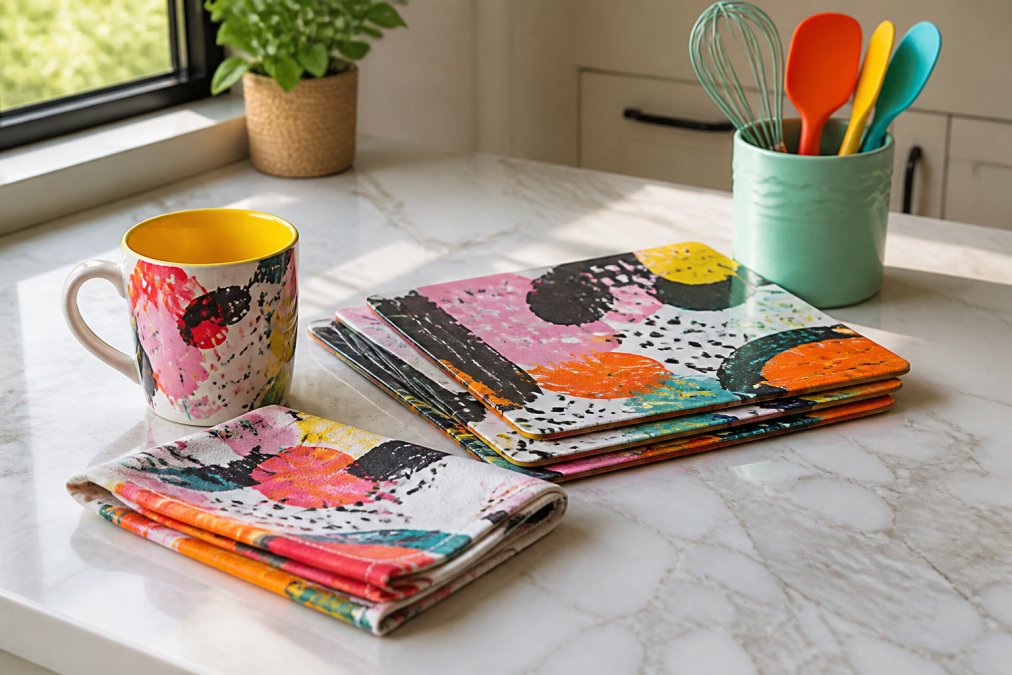
Start with a placemat set. The Graffiti Love Placemat Set gives you four water-resistant placemats, each with a different pattern, for $40.52. That variety matters: mismatched patterns read as intentional, while four identical mats read as a hotel breakfast buffet. The water-resistant finish also means a spilled glass of red wine wipes clean instead of setting a stain into the weave.

Layer in cloth napkins next. The Graffiti Love Cloth Napkin Set costs $35.04 for four, made from soft broadcloth with a printed top and plain white underside.

Small Kitchen Gadgets in Vibrant Hues
The table is the entry point, but the counter is where color earns its keep. Small gadgets are the highest-impact, lowest-cost way to carry a palette through a kitchen because they sit out in plain view and get touched every day.
A few categories do the most work:
- Utensil crocks and utensil sets.
- Mugs. The Joy Mug with Color Inside runs $15.63 in ceramic with a colored rim, handle, and interior, so the color shows up when you're drinking, not just when it sits on a shelf. The Black Boho Flowers Glossy Mug costs $10.50 and is dishwasher and microwave safe, which matters more than most buyers expect. A mug you can't microwave stops being used by week two.
- Hand towels. The Salt Marsh Hand Towel is $13.63, with a vibrant printed front and an absorbent cotton back. Hanging one on the oven handle is the cheapest color upgrade in the room.
- Small appliances. A colored kettle, toaster, or stand mixer is the anchor piece most people buy last, but it is also the piece that locks the palette in place. Buy it after the small stuff, not before.
High-Impact, Low-Cost Color Integration
The reason to start at the table and the counter is budget. A full kitchen repaint or cabinet refacing runs into the thousands; a coordinated set of placemats, napkins, mugs, and towels can transform the same room for well under $150. That is the whole argument for small-format color: you get a significant visual payoff for a fraction of the cost, and you can change your mind next season without a contractor.

Best Colorful Cookware Sets and the Materials That Last
The best colorful cookware sets balance color retention against heat performance. Color is easy to apply and hard to keep, so material choice decides whether your pans look new in year three or faded by month six.
Enamel, Silicone, and Ceramic: What to Look For
Enamel holds color best under high heat because the finish is fused to the metal beneath it. Silicone handles stay cool and resist staining, which makes them the practical choice for utensils that touch turmeric, tomato, and beet. Ceramic offers the widest color range and the smoothest nonstick surface, but it chips if you stack pans without protection.
Here's how the three compare on the factors that actually affect how long your color lasts:
| Material | Color Retention | Heat Tolerance | Best For | Main Trade-Off |
|---|---|---|---|---|
| Enamel | Excellent | High | Dutch ovens, skillets | Heavy; chips on impact |
| Silicone | Good | Medium | Utensils, spatulas | Absorbs odors over time |
| Ceramic | Very good | Medium-high | Frying pans, bakeware | Coating wears with metal tools |
Food-safe finishes matter more than color depth. Look for lead-free and BPA-free labeling on anything that touches food, especially mugs and serving pieces.
How to Style a Colorful Kitchen Without Overdoing It
Styling a colorful kitchen comes down to restraint in three places: how many colors you use, where you place them, and what stays neutral. Most people who "overdo it" have simply spread five colors evenly across every surface instead of concentrating them.
Use the 60-30-10 split. Sixty percent of the room stays neutral (walls, cabinets, large appliances), thirty percent carries your secondary color, and ten percent delivers the accent. A deep green cabinet run with off-white walls and a terracotta accent layer follows this without looking busy.
Merrick Design and Build took a related approach in a recent renovation, integrating three distinct colors, green, off-white, and walnut, to modernize a kitchen without letting any single one dominate. TriVistaUSA went further, painting walls deep purple and layering bright yellow through furnishings rather than fixtures.
Color Palettes That Work in Modern Kitchens
Three palettes hold up across most modern layouts:
- Deep green + off-white + brass. Pairs with wood counters and reads calm at night.
- Navy blue + warm white + terracotta. Higher contrast, works well in open-plan spaces.
- Matte black + cream + one saturated accent. The safest route if you want color to stay in the small pieces.
DeWaard & Bode notes that deep greens and navy blues are the standout appliance colors for 2026, which means your small pieces can echo your large ones instead of competing with them.
Colorful Kitchenware for Modern Homes: Mugs, Placemats, and Everyday Pieces
Colorful kitchenware for modern homes earns its place through daily use, not display. The pieces you touch every morning do more for a room's character than anything you hang on a wall.
Mugs are the entry point. The Joy Mug with Color Inside runs $15.63 in ceramic with a colored rim, handle, and interior, so the color shows up when you're drinking, not just when it sits on a shelf. The Black Boho Flowers Glossy Mug costs $10.50 and is dishwasher and microwave safe, which matters more than most buyers expect. A mug you can't microwave stops being used by week two.
Hand towels carry color into the same room without adding clutter. The Salt Marsh Hand Towel is $13.63, with a vibrant printed front and an absorbent cotton back.
Cleaning and Care for Colorful Finishes
Cleaning colorful finishes is mostly about avoiding heat, abrasives, and sudden temperature swings. Pigment sits on or near the surface of most printed and coated kitchenware, so anything that scratches, overheats, or thermally shocks the surface takes color with it. The failure mode differs by material, and so does the fix.
Why Each Material Fades Differently
Enamel is powdered glass fused to steel at roughly 1,400-1,500°F, so the color is part of the surface rather than a coating on top of it. That is why enamel holds color better than any other finish, but the same glass layer is brittle. A chip exposes bare steel, which then rusts. Never plunge a hot enameled Dutch oven into cold water; thermal shock can craze the glass and create hairline cracks that trap food.
Silicone is a rubber, not a coating. It holds color well but is porous at the molecular level, which is why it absorbs the pigments in turmeric, tomato, and beet over time. Silicone also has a heat ceiling, most food-grade silicone is rated to about 450°F, and pushing past that degrades the polymer and dulls the color permanently.
Ceramic nonstick coatings offer the widest color range and the smoothest release, but the coating is the thinnest of the three. Metal utensils, stacking without protection, and dishwasher detergent all shorten its life. Hand wash ceramic-coated pans with a soft sponge and mild dish soap, and never use cooking spray, the lecithin in aerosol sprays bakes onto ceramic and creates a sticky film that traps pigment and food.
The Non-Toxic Pigment Question
Color in kitchenware comes from pigments and dyes, and not all of them are equally safe. The two you want to see on a label are lead-free and cadmium-free. Historically, reds, oranges, and yellows were the colors most likely to be formulated with cadmium or lead-based pigments, which is why bright glazes on imported ceramics deserve a second look. In the United States, the FDA sets leachable lead limits for ceramicware under its compliance policy guide, and California's Proposition 65 requires warning labels for products that exceed strict thresholds.
For silicone, look for food-grade or LFGB certification rather than generic "BPA-free" claims. BPA-free only tells you what is not in the plastic; it says nothing about the fillers used to color the silicone.
Six Habits That Protect Color Long-Term
- Wash printed textiles in cold water and air dry. The Salt Marsh Hand Towel label specifies a maximum of 90°F, no bleach, no ironing, no dry cleaning.
- Skip abrasive sponges and steel wool on ceramic and enamel. A soft sponge and dish soap handle nearly everything.
- Stack pans with a cloth, felt, or silicone pad between them. Chips start at contact points.
- Let pans cool before washing. Thermal shock is the single fastest way to craze enamel.
- Hand wash ceramic-coated pieces even if the label says dishwasher safe. Detergent is abrasive over hundreds of cycles.
- Store utensils in a crock, not a drawer. Metal-on-silicone contact in a drawer is a slow color-killer.
Stain-resistant finishes help, but they do not make a piece indestructible. A water-resistant placemat handles spills and wipes clean. Treat color as a finish that needs maintenance, not a property that lasts forever.
Conclusion
The hard part of building a colorful kitchen isn't picking a color. It's committing to one palette and letting it live on the pieces you actually use every day. theJoyincolor curates exactly that kind of kitchenware, from water-resistant placemat sets and soft cloth napkins to lead-free, BPA-free ceramic mugs and printed hand towels, all chosen for how they look and how they hold up. Get started with theJoyincolor and build a kitchen where the color is the everyday thing, not the special occasion.
Frequently Asked Questions
How do I choose a color palette for my kitchen?
Start with one anchor color you already love, then build around it. The NKBA 2026 Kitchen Trends Report found 96% of respondents still choose neutrals as their base, while greens (86%) and blues (78%) lead as accent trends. Pick a neutral backdrop, add one or two bold colors through colorful kitchenware like mugs, placemats, or cookware, and keep the rest quiet. This keeps the space cohesive without feeling chaotic.
Are colorful kitchen appliances worth the investment?
It depends on how long you plan to keep them. Deep greens, navy blues, and matte black are among the top appliance color trends for 2026, according to DeWaard & Bode. If you want commitment-free color, start with smaller colorful kitchenware such as mugs, placemats, or hand towels. These let you test a palette before spending on large appliances, and they are easy to swap when your taste shifts.
How can I add color to a neutral modern kitchen?
Layer color through functional decor rather than permanent fixtures. A set of multicolor placemats, cloth napkins, or a ceramic mug with a colored rim can shift the mood of a neutral kitchen in seconds. You can get a similar effect on a smaller scale with countertop displays and open shelving styled with vibrant pieces.
Is it better to mix and match kitchenware colors or keep them uniform?
Mixing works when you follow one rule: repeat at least one color across every piece. Choose two or three colors, then distribute them across cookware, utensils, and tableware so the palette feels intentional rather than random.
How do I maintain the finish on colorful ceramic kitchenware?
Check the care instructions for each piece before you buy. Many ceramic mugs are dishwasher and microwave safe, but hand towels and printed textiles often need cold water washing and should not be tumble dried with heat. For colorful cookware, avoid abrasive scrubbers that dull enamel or nonstick coatings. Storing mugs and plates with a felt or paper layer between them prevents surface scratches that make colors look faded.