

Table of Contents
- Maison Balzac vs Mud Australia: At a Glance
- Material Durability: Glass vs Stoneware
- Pricing Breakdown: Investment Pieces and Premium Colors
- How to Style Colored Glassware with Ceramics
- Aesthetic Home Decor Gift Ideas for Hosts
- Care and Maintenance for Longevity
- Verdict: Which Brand Fits Your Table?
- Frequently Asked Questions
Last Updated: September 28, 2026
Maison Balzac vs Mud Australia: At a Glance
The Maison Balzac vs Mud Australia decor comparison comes down to one core split: translucent glass versus matte stoneware. Maison Balzac is a design-led homewares brand known for vibrant glassware, while Mud Australia is a maker of handcrafted ceramics with a minimalist design language.
Both brands sit inside a home decor market valued at USD 258.1 billion in 2026, with a projected growth rate of 6.9% through 2036, according to Future Market Insights home decor market report. That scale matters: artisan homeware is no longer a niche purchase.
Here's the short version. Glassware brings visual contrast and light. Stoneware brings weight and everyday durability. Most well-styled tables use both.
Comparison Table: Materials, Price, and Care
| Factor | Maison Balzac | Mud Australia |
|---|---|---|
| Primary material | Translucent colored glass | Glazed stoneware ceramic |
| Signature look | Vibrancy, sculptural form | Matte finish, minimalist design |
| Best use case | Tabletop styling, entertaining | Daily functional decor |
| Care profile | Hand wash recommended | Generally dishwasher-friendly |
| Color pricing | Premium tiers on select colors | Tiered pricing on certain hues |
| Strength | Aesthetic appeal, light play | Tactile quality, heirloom durability |
Material Durability: Glass vs Stoneware
Stoneware wins on everyday durability. Glass wins on visual impact.
That's the honest trade-off, and most comparisons skip it. Stoneware is fired ceramic, which gives it a dense, chip-resistant body suited to daily use. It handles heat, holds up to regular washing, and ages without losing its matte finish. This is why Mud Australia pieces are often described as heirloom quality.
Glass behaves differently. It's stronger than people assume, but it's still more vulnerable to thermal shock and hard knocks. A glass carafe or set of goblets can last years with careful handling. Drop it on a tile floor and the story ends fast.
A common mistake is treating glassware as fragile and stoneware as indestructible. Neither is quite right. Glass is tough but temperature-sensitive. Stoneware is durable but can chip at the rim if stacked carelessly.
In practice, this means your glassware earns a spot on the table for hosting, while stoneware does the daily work. That division is exactly why designers layer them.
Pricing Breakdown: Investment Pieces and Premium Colors
Both brands sit in the affordable luxury homewares bracket, and both use tiered color pricing, but the mechanism behind the tiers is different, and understanding it tells you where your money actually goes.
Why saturated colors cost more. In glazed stoneware, deep reds and oranges are the hardest glazes to control. The metallic oxide pigments that produce those hues are sensitive to kiln temperature and atmosphere, so a higher percentage of pieces come out of each firing with uneven color or surface flaws. Makers price those colors higher to absorb the loss rate. Neutral glazes, off-white, sand, pale grey, are far more forgiving, which is why they anchor the lower tier of most ceramic lines. Mud Australia follows this pattern: its standard neutral palette sits at the entry price, while certain saturated hues carry a premium.
Why colored glass costs more. Glass color comes from metal oxides added to the melt, and the same logic applies, the more saturated the tone, the more precise the batch control has to be. On top of that, sculptural forms (handles, asymmetric rims, fluted bodies) are slower to produce than a plain tumbler, and that labor shows up in the price. Maison Balzac positions its glassware as design-led investment pieces: you are paying for form and color, not volume.
The real objection. The question we hear most is simple: why pay artisan prices when a mass-market option looks similar in a photo? The answer is material and finish. A handcrafted stoneware plate has a glaze texture, weight, and slight variation from piece to piece that molded ceramic does not replicate. In person, the difference is obvious; in a thumbnail, it is not. Whether that gap is worth the spend depends entirely on how often you use the piece.
A practical way to budget. If you want the layered look without a full artisan spend, put your budget into one anchor piece per setting. A single colored glass carafe or one set of goblets lifts an entire table of neutral ceramics. Buy the neutral base in a durable everyday material, then spend the premium on the accent that gets seen.
How to Style Colored Glassware with Ceramics
Styling colored glassware with ceramics works best when you treat the glass as the accent and the ceramic as the base. The goal is balance, not competition.
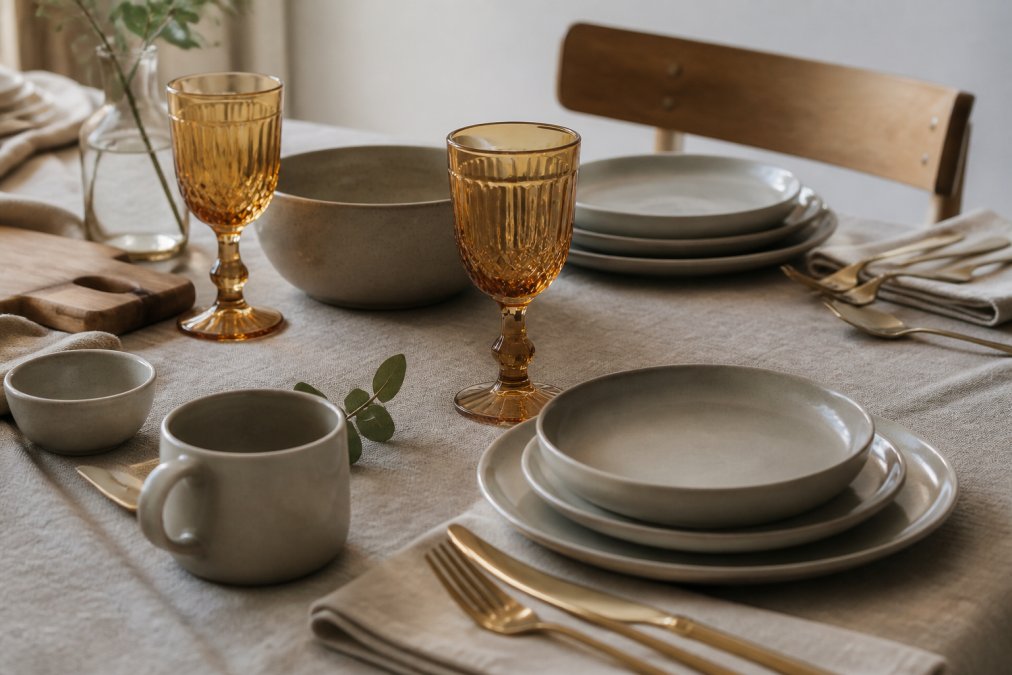
Designers increasingly layer translucent glassware with neutral ceramics to create balanced, textured table settings, a pairing highlighted in Mud Australia's styling features. The logic holds up: glass adds light and movement, ceramics add weight and calm.
A simple framework for tabletop styling:
- Pick one ceramic base. Neutral stoneware plates and bowls for every seat.
- Add one glass accent. A carafe, a set of goblets, or both in the same color family.
- Keep the palette to two tones. One saturated color against one neutral.
- Vary height. A tall carafe next to low plates creates depth.
- Leave negative space. Empty table surface makes the color read stronger.
For a mug that carries the same idea at a lower entry point, theJoyincolor's Joy Mug with Color Inside pairs a neutral exterior with a colored rim, handle, and interior.

Aesthetic Home Decor Gift Ideas for Hosts
Aesthetic home decor gift ideas work best when they are useful and beautiful at once. Hosts get plenty of candles. They rarely get a piece they will actually use weekly, and the difference between a gift that gets used and one that gets stored comes down to three things: it has a job, it fits the recipient's existing palette, and it does not require special care they did not ask for.
Some options that land well:
- A single sculptural glass piece for a host who entertains
- A set of stoneware bowls in a neutral glaze that suits any table
- A colored mug for someone building a curated collection
- A carafe that doubles as a vase for a host short on storage
Care and Maintenance for Longevity
Care determines whether artisan homeware lasts five years or twenty.
A care comparison at a glance:
| Task | Glassware | Stoneware |
|---|---|---|
| Daily washing | Hand wash preferred | Dishwasher generally fine |
| Heat exposure | Avoid thermal shock | Oven-safe on most pieces |
| Storage | Upright, spaced | Stacked with care |
| Biggest risk | Cracking, chipping | Rim chips, glaze wear |
Verdict: Which Brand Fits Your Table?
Pick Mud Australia if you want pieces that work every day and improve with age. The stoneware is durable, and the matte finish reads as minimalist design.
Frequently Asked Questions
What is the main difference between Maison Balzac and Mud Australia glassware?
Maison Balzac focuses on translucent colored glassware with a playful, whimsical design aesthetic, while Mud Australia specializes in handcrafted stoneware ceramics with a matte finish. The core difference is material: glass offers visual contrast and lightness, while stoneware provides durability and a tactile quality. Many designers layer both for a balanced table setting.
Is Mud Australia porcelain dishwasher safe?
Mud Australia stoneware is designed for daily use and is generally dishwasher safe, though hand washing is recommended to preserve the glaze texture over time. Always check the specific care instructions for each piece. For a similar everyday option, theJoyincolor's glossy mugs are explicitly dishwasher and microwave safe, making them a practical choice for routine use.
Does Maison Balzac offer a wider range of colored glassware?
Maison Balzac is known for its vibrant, translucent glassware in a variety of colors, including carafes and goblets. The brand's aesthetic appeal lies in its ability to add visual contrast to neutral ceramics. For a budget-friendly alternative, theJoyincolor offers the Joy Mug with Color Inside at $15.63, which brings a similar splash of color to your tabletop styling.
Which brand is better for minimalist home decor?
Mud Australia is often preferred for minimalist design due to its neutral palette and matte finish, which blends seamlessly into contemporary spaces. Maison Balzac's colored glassware can also work in minimalist settings as a sculptural accent. The key is balance: use one statement piece to avoid clutter. A simple ceramic mug like theJoyincolor's Forget Me Not at $11.63 can serve as an affordable minimalist accent.
How do the price points compare between Maison Balzac and Mud Australia?
Both brands sit in the premium homeware segment, with Mud Australia using a tiered pricing structure where certain colors cost more. Maison Balzac glassware is similarly positioned as an investment. For shoppers seeking aesthetic home decor gift ideas under $20, theJoyincolor offers ceramic mugs starting at $11.63, providing a design-led alternative without the premium price tag.
Building a table that feels curated rather than assembled takes time, and the pieces you choose carry most of that weight. theJoyincolor offers a curated selection of mugs and home goods designed to bring vibrancy to everyday routines, with quality and aesthetic appeal built into every item. Browse the collection to find pieces that work as well on a Tuesday morning as they do at a dinner party. Get started with theJoyincolor and build a table setting that reflects your own color.