

Table of Contents
- Start with Your Story: The First Step in Storytelling in Interior Design
- Interior Design Narrative Examples You Can Steal
- How to Create a Mood Board for Beginners
- Personalizing Home Decor with Meaningful Objects
- Build the Narrative: Color, Texture, and Flow
- Budget-Friendly and Sustainable Storytelling
- Conclusion
- Frequently Asked Questions
Last Updated: September 18, 2026
Start with Your Story: The First Step in Storytelling in Interior Design
Storytelling in interior design for beginners starts with one question: what do you want your home to say about you?
That shift matters. For beginners, that's good news. You don't need a big budget or a design degree. You need a clear story, and a way to turn that story into decisions you can actually make at a store or a thrift shop.
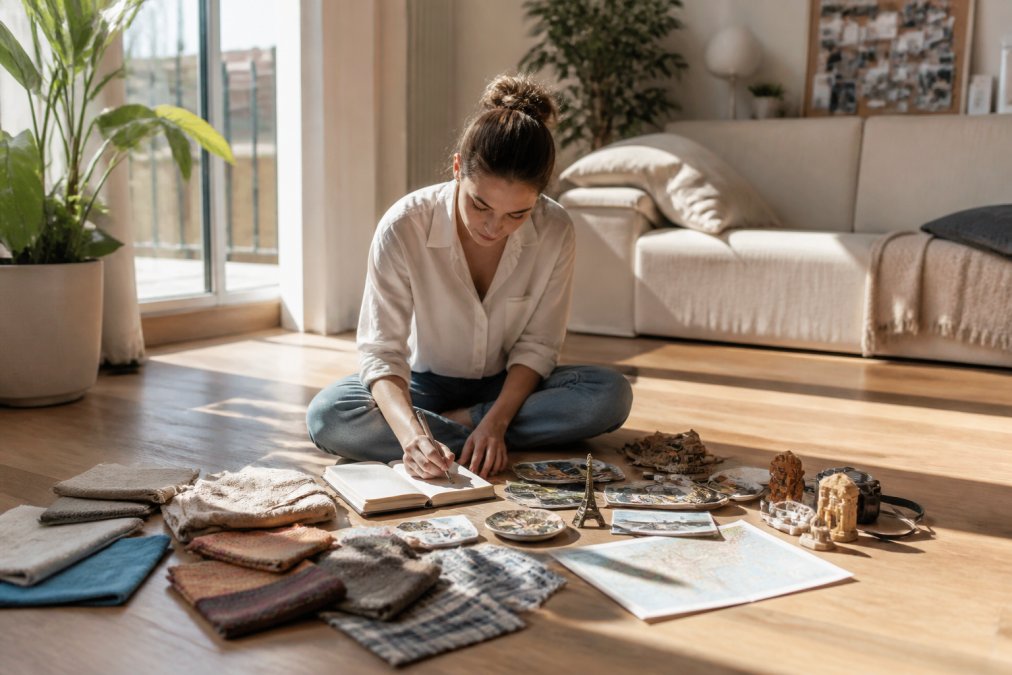
A common mistake is starting with a style label. "Modern farmhouse" or "quiet luxury" tells you nothing about your own life. Start with memories instead.
The 5-Step Story-to-Space Framework
Most guides stop at "find your story." That's the easy part. The hard part is translating a feeling into a sofa, a paint color, and a lamp. This framework closes that gap. Work through it in one sitting with a notebook.
Step 1, Write your one-sentence story. Finish this line: "This room is where I ______." Examples: "This room is where I slow down on Sunday mornings." "This room is where my family argues about movies." One sentence. No adjectives you'd find in a catalog.
Step 2, Pull three anchors. An anchor is a real object, place, or memory that proves the sentence. If your sentence is about slow Sunday mornings, anchors might be your grandmother's ceramic mug, a photo from a cabin trip, and the smell of coffee. Anchors are non-negotiable. They stay in the room.
Step 3, Name the feeling in one word. Cozy. Bright. Grounded. Playful. This word becomes your filter. Every purchase, every rearrange, every paint swatch gets tested against it. If it doesn't serve the word, it doesn't come in.
Step 4, Translate the word into three design levers. Use this starter map, then adjust:
| Feeling word | Color direction | Texture direction | Light direction |
|---|---|---|---|
| Cozy | Warm neutrals, amber, rust | Wool, boucle, raw wood | Lamps, candles, dimmers |
| Bright | White base, one saturated pop | Smooth ceramic, glass, linen | Daylight, sheer curtains |
| Grounded | Earth tones, olive, clay | Stone, jute, leather | Low warm pools of light |
| Playful | Two or three bold hues | Patterned fabric, glossy tile | Colorful shades, string lights |
Step 5, Write a one-page brief. This is the step almost no beginner guide includes, and it's the one that saves the most money. Your brief has five lines: the sentence, the three anchors, the feeling word, the color direction, and the texture direction. Tape it inside a cabinet door.
Why the Brief Beats the Mood
Beginners often skip the brief because it feels like homework. But the brief is what stops the two most expensive beginner mistakes: buying a piece that's beautiful but off-story, and buying three pieces that each tell a different story. A brief takes about 30 minutes and typically prevents at least one return. That's the whole point, the story isn't decoration, it's the filter.
Interior Design Narrative Examples You Can Steal
The clearest interior design narrative examples come from spaces that tell one story well. A coastal home that uses only driftwood tones and sea glass accents. A reader's apartment built around a single inherited armchair.
Here are three starter narratives:
| Narrative | Core Idea | Key Objects | Best Room |
|---|---|---|---|
| The Traveler | Places you've been | Maps, textiles, photos | Living room |
| The Collector | Things you love | Books, art, records | Study or den |
| The Minimalist | Calm and clarity | Few, quality pieces | Bedroom |
How to Create a Mood Board for Beginners
To create a mood board for beginners, gather images, colors, and textures that share a feeling, then arrange them on one page before you buy anything. The mood board is your test run. It shows whether your story holds together.
Here's the simple version:
- Collect 15-20 images from magazines, photos, or free stock sites
- Pull five colors that repeat across those images
- Add three texture samples: wood, fabric, stone, or paper
- Cut anything that doesn't fit the feeling you want
- Arrange everything on one board or digital canvas
Personalizing Home Decor with Meaningful Objects
Personalizing home decor with meaningful objects means giving each item a reason to be there. A bowl from a trip. A pillow in a color your grandmother loved. A book you've read three times.
Three rules for picking meaningful objects:
- If you can't explain why it's there, it goes
- Group items in odd numbers for balance
- Mix old and new, not just new
Build the Narrative: Color, Texture, and Flow
Color, texture, and flow are the three tools that turn a story into a room. Color sets the mood. Texture adds depth. Flow controls how the eye moves through the space. But there's a fourth layer most beginner guides skip: how the story you build actually changes how you feel and behave in the room day to day. That's the psychological layer, and it's where narrative design earns its keep.
Color: The Emotional Volume Knob
Color psychology does most of the emotional work. Warm tones like terracotta and mustard feel inviting. Cool tones like sage and slate feel calm. Pick one dominant color and two supporting ones. Then repeat them in at least three places per room, a wall, a textile, and a small object is the simplest version.
- Bedroom, cool, low-saturation tones (slate, dusty blue, soft gray) support wind-down. Bright saturated reds and oranges tend to read as alert, which fights sleep.
- Home office, a mid-tone green or blue in the sightline behind your screen supports sustained focus better than a blank white wall, which most people find fatiguing over a full workday.
- Living room, warm neutrals plus one saturated accent give the eye a place to rest and a place to land. All-neutral rooms often feel unfinished; all-saturated rooms feel loud.
- Entryway, one strong color or one strong object signals "you're home" within the first three seconds. This is the highest-leverage square footage in the house for narrative.
Texture: The Body's Cue
Texture layering keeps a room from feeling flat. A Reimagine Home 2026 trends analysis notes a shift toward tactile materials and clarity over sterile, minimalist rooms. So mix a soft pillow with a rough wood table and a smooth ceramic vase.
- Soft: wool, boucle, velvet, cotton
- Hard: stone, metal, glass, lacquered wood
- In between: linen, rattan, leather, raw wood
Flow: The Story's Pace
Spatial flow is about sightlines. Walk into the room and ask: where does my eye land first? That spot should hold your most meaningful object.
Three flow checks for beginners:
- Stand in the doorway. If your eye lands on clutter or a blank wall, move the anchor object there.
- Walk the main path. If you have to sidestep furniture, the room is fighting its own story.
- Sit in the main seat. If you can't see your anchor object, the narrative is hidden from the person who uses the room most.
The Well-Being Payoff
A common pattern practitioners describe: when a room's narrative matches the resident's actual daily habits, the room gets used more and tidied more easily, because every object has a reason and a home. When the narrative is borrowed from a trend, the room tends to feel like a showroom, pretty in photos, slightly off in person. The fix isn't more decor. It's a tighter story.
Budget-Friendly and Sustainable Storytelling
Budget-friendly storytelling works because meaning doesn't cost much. Most guides push a full remodel. You don't need one. You need a few well-chosen pieces and a clear point of view.
A quick budget plan:
- 60% on pieces you use daily
- 30% on one statement item per room
- 10% held back for swaps and tweaks
Conclusion
The hard part isn't finding a story. It's trusting that yours is enough. You don't need a designer's eye or a big budget. You need a few honest choices, repeated with intention.
Frequently Asked Questions
What is storytelling in interior design?
Storytelling in interior design means using your space to communicate a personal narrative through objects, colors, textures, and layout. Instead of copying a catalog look, you layer items that hold meaning, like a textile from a trip or a piece of art that reflects your identity. The goal is a room that feels like you, not a showroom.
How do I start a design narrative for my home?
Begin by writing a one-paragraph story about how you want to feel in the room and what you want it to say about you. Then gather five to ten objects that connect to that story. Use your paragraph as a filter: if an item does not support the feeling you described, leave it out.
What is the difference between a theme and a story in interior design?
A theme is a surface-level style like coastal or farmhouse, while a story is the personal why behind your choices. A theme might mean blue and white stripes; a story might mean the summer you spent sailing with your grandfather. The theme is the look, the story is the meaning.
How can I tell my story on a small budget?
Use what you already own first. Rearrange meaningful objects, group photos, or layer inherited textiles instead of buying new. Add one or two affordable accents, like a $17.13 accent pillow from theJoyincolor, to tie the palette together. Thrift stores, estate sales, and free community exchanges also supply narrative pieces at low cost.